 World Certification Institute – WCI | Global Certification Body World Certification Institute (WCI) is a global accrediting and certifying body that confers professional credentials to qualified individuals and accredits eligible courses offered by organizations such as universities, colleges, schools, professional institutions, and training companies.

As someone who stepped into the finance world in the early 1980s, just as companies were dipping their toes into Enterprise Resource Planning (ERP) systems, I’ve seen technology revolutions up close. Back then, firms were transitioning from clunky, custom-built systems to more structured ERP platforms. It wasn’t smooth, many stumbled on over-customization, leading to bloated budgets and brittle operations. But the ones that succeeded embraced modular standards and disciplined implementation, unlocking efficiency that redefined industries.
Fast forward to today, and AI stands at a similar crossroads. In 2026, AI is shifting from buzzworthy experiments to tangible business applications, much like ERP did when it moved beyond hype to deliver real outcomes. The winners won’t be those chasing the shiniest models; they’ll be the organizations that prioritize application-layer value and rigorous rollout strategies. Just as ERP standardized transactions to streamline operations, AI is poised to standardize and accelerate decisions, turning data into decisive action. This isn’t about more pilots, it’s about disciplined implementation that drives speed, quality, and strategic edge.
Understanding the AI Value Stack
To understand where true business value emerges, consider the 5-layer AI stack. It’s a hierarchy that mirrors the ERP evolution, where hardware and platforms were foundations, but benefits only materialized through process adoption.
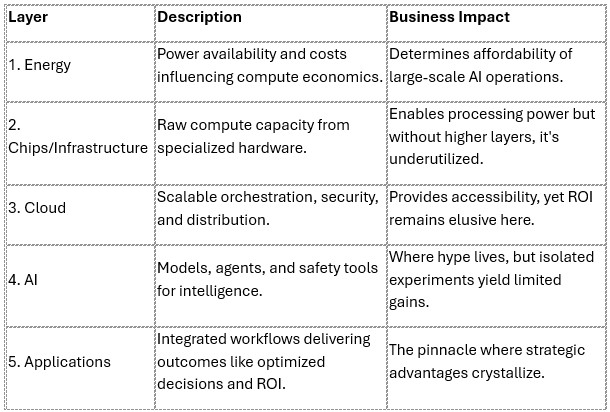

Most conversations today fixate on layers 2–4, debating chip wars or model tweaks. But as with ERP, where data centers and platforms were table stakes, the real ROI hits at layer 5. Think of ERP’s journey: from basic hardware to modular software, value only flowed when processes were adopted enterprise-wide. AI follows suit; without application focus, you’re building castles on sand.
Learning from ERP’s Hard-Won Lessons
Drawing from ERP’s hard-won lessons, avoid repeating the legacy era blunders. Early ERP adopters, stuck in a customization mindset, poured resources into bespoke code, resulting in overruns, fragile systems, and outright failures. I remember projects ballooning significantly over budget because teams couldn’t resist tweaking every line.
The turning point? Shifting to standard packages with configurable modules. This approach emphasizing standardization by industry best practices while tailoring to unique needs accelerated adoption and reduced risks. For AI, apply the same ingenuity: standardize the core (platforms, security, governance, data pipelines) while flexing the edges (prompts, workflows, role-specific copilots, approval gates). This approach sidesteps complexity, fostering resilient systems that scale. Ingeniously, it humanizes AI by embedding it into daily workflows, empowering teams rather than overwhelming them.
Define Clear Implementation Objectives
Before diving into builds, define crystal-clear implementation objectives. AI projects flop when they pursue flashy capabilities over measurable results, echoing ERP initiatives that chased features without benefits tracking. Start with an executive mandate: “We implement AI to gain strategic advantage, boost speed and quality, cut costs, fortify supply chain resilience, and supercharge sales/marketing, all while upholding governance and rapid time-to-value.”
The top ERP programs baked in benefits realization from day one, not as a post-go-live afterthought. In AI, this means aligning every use case to outcomes, ensuring investments pay off swiftly.
Strategic Advantage, Efficiency, and Speed
For strategic advantage, AI supercharges scenario planning, forecasting, and risk detection. Imagine compressing strategy cycles from weeks to hours, or elevating bid win rates through predictive insights. Key performance indicators (KPIs) include forecast accuracy improvements, decision cycle time reduction, and strategic initiative success rates.
On efficiency, AI eradicates drudgery like manual reporting or reconciliations, freeing teams for high-value work. Track hours saved per process, reduced handoffs, and throughput per employee for substantial productivity gains. Speed of execution shifts from batch decisions to real-time interventions, slashing issue-resolution times and order-to-ship cycles. These aren’t abstract; they’re grounded in ERP’s discipline, where AI amplifies existing processes.
Manufacturing, Quality, and Cost
Speed of manufacture leverages AI for dynamic planning and bottleneck resolution, boosting overall equipment effectiveness (OEE) and schedule adherence. Quality surges with predictive defect spotting, cutting scrap rates and improving first-pass yields. Cost efficiency targets unit costs and logistics without compromising service, measuring reductions in expedites and waste. Parallel to ERP, which instilled process rigor, AI enforces decision discipline within those flows, think AI agents optimizing production in real-time.
Supply Chain Resilience and Optimization
Supply chain resilience demands early disruption alerts and automated playbooks, like rerouting suppliers. KPIs include lower stockout rates, improved supplier on-time-in-full (OTIF), and faster recovery. Inventory optimization balances capital with availability, tracking days inventory and fill rates. Planning accuracy refines demand sensing for stable sales and operations planning (S&OP), minimizing mean absolute percentage error (MAPE) and reschedules. Crucially, AI thrives on ERP/SCM as the data backbone without clean, operational truth, it’s guesswork.
Sales, Marketing, and Growth
In sales and marketing, AI drives growth through refined pipelines and accelerated deals, improving win rates and cycle times. Pricing discipline uses guardrails to curb discount leakage, preserving margins. Marketing gains speed in content creation with personalization, elevating conversions and customer acquisition cost-to-lifetime value ratios. Brand governance ensures “safe-to-publish” checks, reducing compliance incidents. Like ERP’s process standardization, AI normalizes content and decisions at velocity, humanizing outreach while scaling impact.
Program Execution and Governance
Finally, program objectives emphasize cost-efficient rollout and governance. Aim for pilot-to-production in weeks, with KPIs like component reuse and rapid benefits realization. Governance includes logging, access controls, and human oversight for risks, measuring incident rates and traceability. Integrate deeply with ERP: “ERP as system-of-record, AI as system-of-insight,” with the majority of use cases rooted in core data.
Conclusion
In closing, 2026’s AI race rewards not the most experiments, but unmatched implementation discipline. Echoing ERP, shun heavy customization; standardize modules by industry, customize edges ingeniously. Define objectives, prioritize high-impact cases, leverage ERP data, and track benefits relentlessly. This isn’t just tech, it is a human-centered transformation, inspiring teams to achieve more with AI as their ally. Let’s make 2026 the year AI truly elevates business.
LEGAL DISCLAIMER
By reading this article, you agree to the following terms:
1. NATURE OF CONTENT This article represents the author’s personal opinions based on professional experience in technology and finance since the early 1980s. It is provided for informational purposes only and is NOT professional advice of any kind—including financial, legal, business, investment, tax, or technical advice. The 5-layer AI stack and frameworks presented are the author’s original analytical constructs, not scientifically validated standards.
2. NO WARRANTIES – CONTENT PROVIDED “AS IS” The author makes no warranties about accuracy, completeness, or suitability of this content. Information may contain errors, be outdated, or be inappropriate for your specific situation. You use this information entirely at your own risk.
3. ZERO LIABILITY To the maximum extent permitted by law, the author’s total liability for any claims is $0. The author, publisher, and affiliated parties are NOT liable for any damages including lost profits, business interruption, data loss, or any other losses arising from your use of this article, regardless of legal theory.
4. YOUR RESPONSIBILITIES
- Consult professionals: You must consult qualified legal, financial, and technical advisors before making any business decisions based on this content
- No guarantees: Past examples do not predict future results. Your results will vary based on countless factors
- Compliance: You are solely responsible for ensuring compliance with all applicable laws and regulations
- Indemnification: You agree to defend and hold the author harmless from any claims arising from your use of this article
5. AI-ASSISTED CONTENT This article was developed with AI tools for research, drafting, and editing. While reflecting the author’s professional judgment, AI-generated content may contain errors, biases, or oversimplifications. The author has reviewed the content but makes no guarantee of accuracy. Readers must independently verify all information.
6. NO RELATIONSHIP CREATED Reading this article creates no professional, advisory, fiduciary, or client relationship. The author owes you no duty of care or ongoing obligation.
7. INTELLECTUAL PROPERTY © 2026. All rights reserved. You may share this article with attribution but may not reproduce, commercially exploit, or use it to train AI models without written permission.
8. LINKEDIN PUBLICATION This article represents only the author’s personal views and does not represent LinkedIn Corporation, any employer, client, or affiliated organization.
9. MODIFICATIONS The author may update or modify this article at any time without notice. This disclaimer may be updated, and continued reading constitutes acceptance of changes.
ACKNOWLEDGMENT: By reading beyond this point, you acknowledge you have read, understood, and agree to be bound by this disclaimer. If you do not agree, stop reading immediately.
Publication Date: February 2026
Copyright: © 2026 John Ho. All rights reserved. This article may be shared with attribution but may not be reproduced in whole or in part for commercial purposes without written permission.
This article was written by Dr John Ho, a professor of management research at the World Certification Institute (WCI). He has more than 4 decades of experience in technology and business management and has authored 28 books. Prof Ho holds a doctorate degree in Business Administration from Fairfax University (USA), and an MBA from Brunel University (UK). He is a Fellow of the Association of Chartered Certified Accountants (ACCA) as well as the Chartered Institute of Management Accountants (CIMA, UK). He is also a World Certified Master Professional (WCMP) and a Fellow at the World Certification Institute (FWCI).
ABOUT WORLD CERTIFICATION INSTITUTE (WCI)

World Certification Institute (WCI) is a global certifying and accrediting body that grants credential awards to individuals as well as accredits courses of organizations.
During the late 90s, several business leaders and eminent professors in the developed economies gathered to discuss the impact of globalization on occupational competence. The ad-hoc group met in Vienna and discussed the need to establish a global organization to accredit the skills and experiences of the workforce, so that they can be globally recognized as being competent in a specified field. A Task Group was formed in October 1999 and comprised eminent professors from the United States, United Kingdom, Germany, France, Canada, Australia, Spain, Netherlands, Sweden, and Singapore.
World Certification Institute (WCI) was officially established at the start of the new millennium and was first registered in the United States in 2003. Today, its professional activities are coordinated through Authorized and Accredited Centers in America, Europe, Asia, Oceania and Africa.
For more information about the world body, please visit website at https://worldcertification.org.


