 World Certification Institute – WCI | Global Certification Body World Certification Institute (WCI) is a global accrediting and certifying body that confers professional credentials to qualified individuals and accredits eligible courses offered by organizations such as universities, colleges, schools, professional institutions, and training companies.

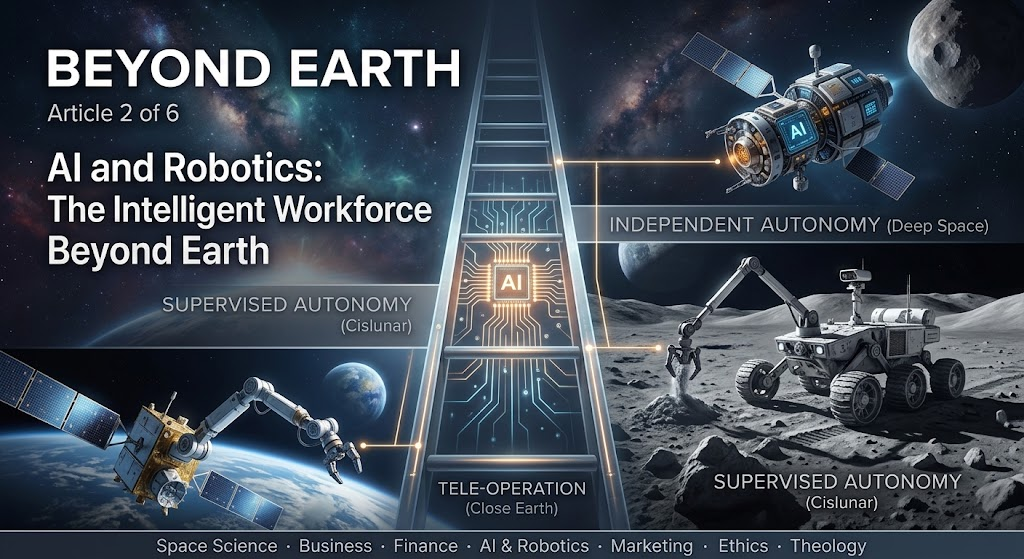
The first workforce of the space economy may not be human at all.
If the first article in this series asked what infrastructure the emerging space economy requires, this second article asks a more fundamental question: who or what will actually perform the work?
For most of human history, expansion into a hostile environment demanded that people physically enter it. Space rewrites that equation. A machine needs no breathable air and none of the elaborate life-support a human body requires. It can labour through repetitive operations for extended periods without fatigue, boredom or risk to life. And once combined with artificial intelligence, it ceases to be a remotely piloted tool and becomes something closer to an autonomous operational system, one capable of sensing, deciding and acting within defined limits.
The workforce may arrive before the workers
This points to a striking possibility: the first workforce of an expanding space economy may be overwhelmingly robotic. Machines can inspect infrastructure, gather scientific data, survey terrain, perform maintenance and assist with construction long before large numbers of people ever follow. The economic logic is straightforward deploy machines where machines are more economical, and reserve human presence for the tasks where human judgement is genuinely indispensable.
This is no longer theoretical. In March 2025, Firefly Aerospace’s Blue Ghost Mission 1 became the first fully successful commercial soft landing on the Moon, delivering ten NASA science and technology payloads to Mare Crisium and operating them across a full lunar day of roughly fourteen Earth days under NASA’s Commercial Lunar Payload Services (CLPS) initiative. A commercial operator, a robotic lander and a suite of instruments accomplished what once demanded a national space agency and a human crew and did so under a NASA task order of roughly US$101 million, with about US$44 million more for the ten payloads. It is a compact preview of how much of the early space economy will be built: privately, robotically and at a small fraction of the cost of an agency-led crewed mission.
AI as the intelligence layer
Robotics supplies physical capability; AI supplies the intelligence layer that directs it. That intelligence tends to fall into three roles. In perception, it helps a system sense terrain, recognise objects and detect anomalies. In reasoning, it plans routes, prioritises incoming information and supports autonomous navigation. In oversight, it monitors equipment health, flags what matters and informs the humans who remain accountable for the mission. Perception, reasoning, oversight and the same division of labour that any well-run operation depends on.
But AI must never be mistaken for magic. Models make errors. Autonomous systems encounter conditions outside the envelope in which they were trained and tested. Communication links drop, sensors drift and hardware degrades in ways no simulation fully anticipated. Space AI therefore demands rigorous testing, redundancy, verification and a level of human oversight proportionate to the mission’s stakes. The NIST AI Risk Management Framework organised around four functions of Govern, Map, Measure and Manage offers a useful, sector-neutral model for managing these risks across the full lifecycle, from design and development through deployment and ongoing evaluation. Its central lesson travels well to orbit: trustworthy autonomy is engineered deliberately; it is never simply assumed.
From automation to autonomy: a ladder set by distance
There is an important distinction between automation and autonomy, and it grows more consequential with distance. Automation executes predefined processes; autonomy involves a system making genuine decisions within defined parameters. A machine operating near Earth can receive frequent instructions and be corrected in near real time. A system operating far away must act with greater independence, because communication delays and intermittent connectivity make continuous human control impractical.
It helps to picture autonomy as a ladder whose rungs are set by distance. On the first rung, close to Earth, tele-operation dominates: humans stay in near-continuous control and the machine mostly executes. On the second rung, in cislunar and lunar space, supervised autonomy takes over: humans set goals and step in periodically, while the system absorbs the seconds of signal delay on its own. On the third rung, in deep space, the machine must exercise bounded independent autonomy acting alone, for long stretches, within limits authorised in advance, because real-time human control is simply not available.
The critical move is what happens to governance as you climb. Each rung demands not only more capability but more constraint: clearer boundaries, better verification and stronger fail-safes. The design principle is therefore twofold, the farther a machine travels from direct human supervision, the greater the importance of intelligent autonomy, and, in equal measure, the greater the importance of the safety boundaries placed around it. Capability and constraint must advance together. An autonomous system without well-defined limits is not an asset; it is a liability waiting for the wrong input. The engineering challenge of the coming decade is not merely to make machines more capable, but to make them more capable and more governable at the same time.
AI at the materials frontier
AI may also reshape one of the most economically intriguing frontiers: materials. Autonomous systems that examine geological environments, analyse samples and flag unusual physical or chemical properties can help scientists narrow immense datasets into a shortlist of candidates. This will not conjure a commercially valuable material on demand; it accelerates the search across a space where materials science, robotics and machine intelligence converge.
The economics of reliability
The economic argument for robotics is powerful, but it holds only when the full lifecycle is counted, design, launch, deployment, operation, maintenance, failure risk, and eventual recovery or replacement. A cheap robot that fails on arrival is not economical. A more expensive system with dramatically higher reliability may deliver far greater lifetime value. This is precisely where engineering and finance meet, and where disciplined capital thinking separates durable ventures from expensive experiments. In an environment where a single failure can end a mission, reliability is not a technical luxury, it is the core of the business case.
The human role does not disappear — it moves up
The rise of intelligent machines does not signal the retreat of human responsibility; it relocates it. Human roles shift toward mission design, scientific interpretation, ethical judgement, strategic management, system governance, risk assessment and commercial leadership. The future workforce is best understood not as machines replacing people, but as a human-AI-robotic partnership in which each element contributes what it does best: machines supply endurance and reach, AI supplies scale and speed, and humans supply purpose, judgement and accountability.
The largest productivity gains may therefore come not from substitution but from amplification. One scientist supported by AI can interrogate far more information than before. One engineer supported by autonomous systems can oversee a larger operational footprint. One organisation can run several robotic missions in parallel. The defining question of this era is not how many workers a venture can remove, but how much more value a single well-supported human decision-maker can create when intelligent machines extend their reach across vast distances.
Beyond Earth, the intelligent workforce is already reporting for duty. The task before us like commercial, technical and ethical alike is to ensure that as our machines grow more capable, our governance, our judgement and our sense of responsibility grow with them.
Which leaves a question worth sitting with, for anyone building in this space: when most of the crew is machine, what is the one thing you would still have a human lead?
References
1. NASA — Primary-source confirmation of the first fully successful commercial lunar soft landing and the delivery of ten NASA payloads under the CLPS initiative.
2. NASA — Context for the public-private model of robotic lunar delivery referenced in the article.
3. Spaceflight Now — Source for the mission cost figures: NASA’s ~US$101 million task order to Firefly plus ~US$44 million for the ten payloads.
4. NIST — Source for the Govern–Map–Measure–Manage lifecycle model of AI risk management.
AI-Assistance Declaration
This article was prepared with the assistance of AI tools used for drafting support, structural editing, reference verification and language refinement. All analysis, argument, professional judgement and conclusions are the author’s own. The author has reviewed, edited and approved the final text, and accepts full responsibility for its content.
Important Disclaimer — Please Read
This article is published for general information, educational and thought-leadership purposes only. It reflects the personal views and professional analysis of the author, Prof. John Ho, and does not constitute investment, legal, engineering, financial, regulatory or professional advice of any kind. It should not be relied upon as a basis for any decision or action.
References to organisations, missions, agencies, frameworks, products or programmes — including NASA, Firefly Aerospace, the Blue Ghost mission, the Commercial Lunar Payload Services initiative and the NIST AI Risk Management Framework are made solely for factual, descriptive and illustrative purposes. All trademarks, service marks and names remain the property of their respective owners. No affiliation, sponsorship, partnership or endorsement is implied. Third-party references are cited nominatively to support factual claims and do not imply any relationship with the author.
While reasonable care has been taken to ensure accuracy at the time of writing, the author and any associated organisation (including the World Certified Institute, WCI) make no representations or warranties, express or implied, as to the completeness, accuracy, reliability or suitability of the information. The space, AI and robotics sectors evolve rapidly; facts, figures and technological details may change after publication. To the fullest extent permitted by law, the author and any associated organisation accept no liability for any loss or damage arising directly or indirectly from the use of, or reliance on, this article. The views expressed are those of the author and not necessarily those of any organisation with which he is affiliated.
This article was written by Dr John Ho, a professor of management research at the World Certification Institute (WCI). He has more than 4 decades of experience in technology and business management and has authored 28 books. Prof Ho holds a doctorate degree in Business Administration from Fairfax University (USA), and an MBA from Brunel University (UK). He is a Fellow of the Association of Chartered Certified Accountants (ACCA) as well as the Chartered Institute of Management Accountants (CIMA, UK). He is also a World Certified Master Professional (WCMP) and a Fellow at the World Certification Institute (FWCI).
ABOUT WORLD CERTIFICATION INSTITUTE (WCI)

World Certification Institute (WCI) is a global certifying and accrediting body that grants credential awards to individuals as well as accredits courses of organizations.
During the late 90s, several business leaders and eminent professors in the developed economies gathered to discuss the impact of globalization on occupational competence. The ad-hoc group met in Vienna and discussed the need to establish a global organization to accredit the skills and experiences of the workforce, so that they can be globally recognized as being competent in a specified field. A Task Group was formed in October 1999 and comprised eminent professors from the United States, United Kingdom, Germany, France, Canada, Australia, Spain, Netherlands, Sweden, and Singapore.
World Certification Institute (WCI) was officially established at the start of the new millennium and was first registered in the United States in 2003. Today, its professional activities are coordinated through Authorized and Accredited Centers in America, Europe, Asia, Oceania and Africa.
For more information about the world body, please visit website at https://worldcertification.org.


