 World Certification Institute – WCI | Global Certification Body World Certification Institute (WCI) is a global accrediting and certifying body that confers professional credentials to qualified individuals and accredits eligible courses offered by organizations such as universities, colleges, schools, professional institutions, and training companies.

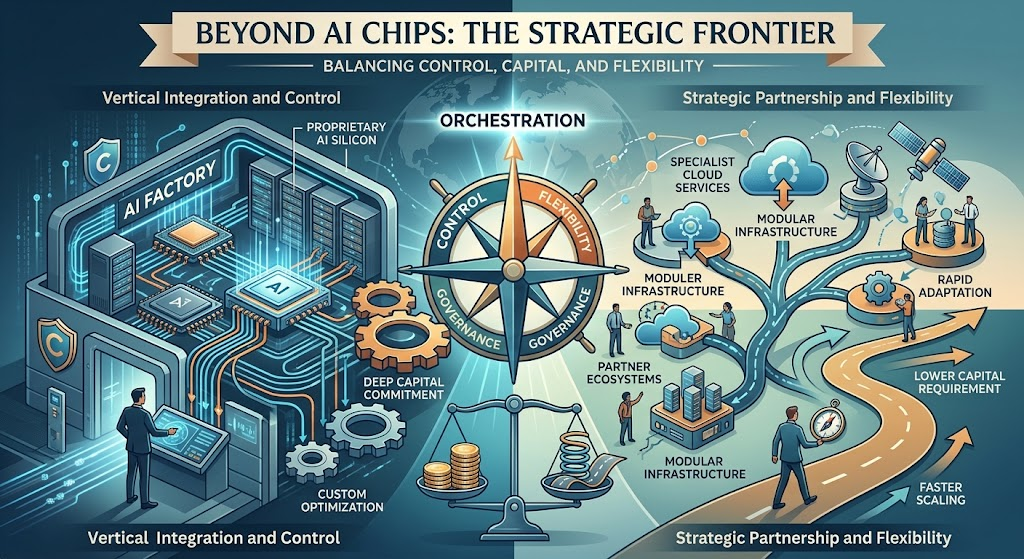
Introduction: A New Strategic Frontier
Artificial intelligence has quietly crossed a threshold. For much of the past decade, the contest was about the model who could train the largest, the smartest, and the most capable system. That race has not ended, but a second and arguably more consequential one has now begun. The new battleground is infrastructure: the computing power, specialised chips, high-speed networking, data centres, software platforms and deployment ecosystems that transform raw research into everyday capability.
As AI becomes a foundational layer across every industry, boards and executives face a question as old as technology itself. Should a company own more of the stack that powers its products, or should it stay lean and flexible by partnering with specialists who have already solved the hardest problems?
This is not merely a technical decision. It reaches deep into capital allocation, risk appetite, competitive differentiation, operational resilience and the long arc of corporate strategy. The rise of the “AI factory” is one influential answer, but it is not the only one, and it is certainly not the right answer for everyone.
The AI Factory: Industrialising Intelligence
Historically, a factory produced physical goods. In the AI era, the metaphor has been reimagined. An AI factory is an integrated infrastructure system engineered to manufacture intelligence at scale. Rather than rolling finished products off an assembly line, it produces training capacity, inference services, intelligent applications and automated decision-making.
Several ingredients combine to make this possible. Advanced accelerators supply raw computing power. High-speed networking stitches vast systems together. Software platforms compress development timelines. Robust data infrastructure feeds continuous learning. And enterprise-grade tools translate all of it into commercial value. The strategic aim is simple to state and hard to achieve to make the deployment of AI faster, easier and more scalable.
Ecosystems Create Gravity
There is a deeper strategic truth here. The most successful infrastructure providers do not merely sell components; they cultivate ecosystems. Once customers build their operations inside a complete environment, moving away becomes costly, and demand becomes self-sustaining.
This pattern recurs throughout computing history. Operating systems nurtured software ecosystems. Mobile platforms spawned app economies. Cloud providers assembled sprawling developer communities. The AI factory follows the same logic: by offering an end-to-end platform, a provider lowers the barrier to adoption, because customers no longer have to piece together every capability themselves. The result is a powerful flywheel, wider adoption drives infrastructure demand, which strengthens the ecosystem, which accelerates innovation, which in turn attracts still more adoption.
But Should Every Company Build Its Own?
Here the strategy becomes genuinely difficult. Not every organisation should own every layer. Before committing capital, leaders must answer a disarmingly simple question: where does our unique advantage actually come from? Two broad paths follow from the answer.
Path One — Vertical Integration: Own What Is Critical
Some organisations conclude that designing hardware and software together is itself the source of advantage. When the two are co-engineered, a company can pursue tighter optimisation, superior performance, greater control and faster innovation cycles.
Google’s development of its Tensor Processing Units illustrates the philosophy well. By building custom silicon tuned to its own workloads and software, Google gains a degree of control that off-the-shelf hardware cannot easily match. The reward is precision. The price is capital intensity, deep research investment, scarce engineering talent, long-term commitment, and a bet that today’s technology direction will still matter tomorrow. The lurking risk is that the ground shifts faster than the investment can pay back.
Path Two — Strategic Partnership: Focus on Differentiation
The alternative is to concentrate investment only where the company creates genuinely distinctive value, and to lean on specialist providers for everything else. Many leading model developers, for instance, rely on cloud and hardware partners rather than constructing complete infrastructure from scratch. The advantages are compelling: lower capital requirements, faster scaling, greater flexibility and reduced exposure to technological obsolescence.
Apple’s long-standing approach is instructive. The company fiercely guards the areas that define it, product design, operating systems, user experience and ecosystem management while entrusting much of its manufacturing to specialised partners. The lesson is not that outsourcing always wins. It is more nuanced: own what differentiates you, and partner for what others can simply do better.
The Historical Warning: Leadership Is Perishable
Technology history offers a sobering reminder today’s champion is not guaranteed to lead tomorrow. The disk-drive industry is the classic case study. Across several decades, the sector lurched through wave after wave of transition: new form factors, rising storage density and shifting customer needs. Companies that dominated one generation frequently stumbled at the next, not through any lack of talent or effort, but because their fixed investments aged faster than the market moved.
The parallel to AI is uncomfortable and important. When change accelerates, the executive’s question is no longer only “how much can we build?” but “how much irreversible capital dare we commit in an environment this fluid?”
Optimisation Versus Flexibility
The next chapter of AI will likely unfold along several tracks at once, larger frontier models, smaller specialised ones, more efficient architectures, purpose-built chips and entirely new computing approaches. Frontiers such as photonic and quantum computing remain emerging rather than imminent replacements, yet they carry a clear message: every technology assumption deserves periodic re-examination. A company investing billions today must ask itself honestly whether that investment will still be strategically valuable if the landscape shifts within five years.
A Board-Level Framework for AI Investment
Before authorising major infrastructure spending, directors can pressure-test the decision against five questions. What truly differentiates us and therefore deserves to be owned? What can partners deliver better, sparing us unnecessary ownership? How quickly is the underlying technology changing, and does that pace demand flexibility? Does owning a given asset create real competitive advantage, or merely the comforting illusion of control? And finally, if the technology shifts, can we adapt without being anchored to stranded investment?
Sound governance turns these questions into a repeatable discipline rather than a one-off debate. This is precisely where clear, ego-neutral decision frameworks earn their keep separating what genuinely differentiates the enterprise from what merely feels reassuring to own.
The Future Winner May Not Be the Largest Owner
The technology industry tends, over time, to reward those who understand where value is truly created rather than those who accumulate the most assets. The AI leaders of the coming decade may not be the organisations that own the most infrastructure. They are more likely to be those that blend technological excellence, financial discipline, well-chosen partnerships, relentless innovation and genuine governance responsibility. The decisive capability may not be ownership at all. It may be orchestration, the art of assembling the right capabilities, owned and borrowed, into a coherent and resilient whole.
Conclusion: Resilience as the Ultimate Advantage
In earlier industrial revolutions, companies competed by owning factories, machines and physical assets. In the AI revolution, the very definition of advantage is being rewritten. The sharpest organisations may stop asking “how much infrastructure should we own?” and start asking “which capabilities must we control, and where can partnership create greater resilience?”
Vertical integration can deliver formidable strength. Strategic partnership can deliver invaluable flexibility. Neither is universally superior; the right answer depends on a company’s distinctive capabilities, financial strength, market position, innovation goals and appetite for risk. As AI keeps evolving, the enterprises that endure and flourish will be those that pair ambition with adaptability. Because in a world where technology now changes faster than capital can depreciate, resilience may prove to be the ultimate competitive advantage.
Strategy Snapshot: The AI Choice Matrix
High control, high flexibility → Hybrid strategy (own the core, partner for the rest)
High control, lower flexibility → Vertical integration (build and own critical technology)
Lower control, high flexibility → Strategic partnership (leverage specialist providers)
Lower control, lower flexibility → Pure outsourcing (minimal ownership, maximum dependence)
Selected References
1. NVIDIA — AI Factories and AI Infrastructure.
2. Stanford Institute for Human-Centered AI (HAI) — AI Index Report.
3. Google Cloud — Tensor Processing Units (TPU).
4. Apple Inc. — Investor Relations.
5. NIST — AI Risk Management Framework (AI RMF).
Disclaimer & AI-Assistance Declaration
Independent opinion. This article represents the personal views and independent analysis of the author, Prof. John Ho, expressed in his individual capacity. It does not represent the views, positions, or official statements of any employer, institution, client, professional body, or organisation with which the author is or has been associated.
Not professional advice. The content is provided for general informational and educational purposes only. It does not constitute and must not be relied upon as financial, investment, legal, accounting, tax, technical, engineering, or other professional advice. Readers should obtain independent professional advice tailored to their own circumstances before making any strategic, commercial, or investment decision. No client, advisory, or fiduciary relationship is created by reading or acting upon this article.
No endorsement or affiliation. References to companies, products, technologies, frameworks, or organisations including any named above are made solely for illustrative, educational, and commentary purposes. They do not imply any endorsement, sponsorship, partnership, affiliation, or association with the author. All observations regarding third parties are drawn from publicly available information and general industry knowledge.
Accuracy and external links. While reasonable care has been taken to ensure accuracy at the time of writing, the author makes no representation or warranty, express or implied, as to the completeness, reliability, or currency of the information. Technology, markets, and cited sources evolve rapidly. External links are provided for convenience only; the author is not responsible for the content, availability, or accuracy of third-party websites.
No liability. To the fullest extent permitted by law, the author accepts no liability whatsoever for any loss, damage, cost, or expense of any kind arising directly or indirectly from any use of, reliance upon, or action taken on the basis of this article or its contents.
Intellectual property. All third-party names, marks, and logos are the property of their respective owners and are used for identification and commentary only. This article and its original text are the intellectual property of the author. No part may be reproduced, redistributed, or repurposed without prior written permission and appropriate attribution.
AI-assistance declaration. This article was prepared with the assistance of artificial intelligence tools for research support, drafting, structuring, and editorial refinement. All final content has been reviewed, verified, curated, and approved by the author, who takes full responsibility for the views expressed and the final published text.
Trademark Notice: The Living Formula™, Universal Reference Table™, Living Formula AGI™, Living Formula Reference System™, Ego-Neutral Advisor™, Neutral Mirror™, and Indirect Advisory™ are proprietary frameworks and trademarks of the author. All rights reserved.
© 2026 Prof. John Ho. All rights reserved.
This article was written by Dr John Ho, a professor of management research at the World Certification Institute (WCI). He has more than 4 decades of experience in technology and business management and has authored 28 books. Prof Ho holds a doctorate degree in Business Administration from Fairfax University (USA), and an MBA from Brunel University (UK). He is a Fellow of the Association of Chartered Certified Accountants (ACCA) as well as the Chartered Institute of Management Accountants (CIMA, UK). He is also a World Certified Master Professional (WCMP) and a Fellow at the World Certification Institute (FWCI).
ABOUT WORLD CERTIFICATION INSTITUTE (WCI)

World Certification Institute (WCI) is a global certifying and accrediting body that grants credential awards to individuals as well as accredits courses of organizations.
During the late 90s, several business leaders and eminent professors in the developed economies gathered to discuss the impact of globalization on occupational competence. The ad-hoc group met in Vienna and discussed the need to establish a global organization to accredit the skills and experiences of the workforce, so that they can be globally recognized as being competent in a specified field. A Task Group was formed in October 1999 and comprised eminent professors from the United States, United Kingdom, Germany, France, Canada, Australia, Spain, Netherlands, Sweden, and Singapore.
World Certification Institute (WCI) was officially established at the start of the new millennium and was first registered in the United States in 2003. Today, its professional activities are coordinated through Authorized and Accredited Centers in America, Europe, Asia, Oceania and Africa.
For more information about the world body, please visit website at https://worldcertification.org.


