 World Certification Institute – WCI | Global Certification Body World Certification Institute (WCI) is a global certifying body that grants credential awards to individuals as well as accredits courses of organizations.

The Foundation of AI Success Lies in Your People, Not Your Technology
The promise of artificial intelligence has captivated organizations worldwide, yet a sobering reality persists: approximately 74% of companies struggle to achieve meaningful value from their AI investments. The culprit? It’s rarely the technology itself. Research consistently reveals that roughly 70% of AI implementation challenges stem from people and process-related issues, not technical deficiencies. This profound disconnect between technological capability and organizational readiness underscores a fundamental truth: building an AI-ready culture is not merely supportive of AI adoption, it is the foundation upon which all successful transformations are built.
Cultural Prerequisites: Building the Bedrock for AI Success
Organizations that successfully integrate AI share distinctive cultural characteristics that separate them from those that struggle. These aren’t superficial attributes but deeply embedded values that shape daily behaviors and decision-making processes.
Psychological Safety: The Courage to Experiment
Psychological safety, the belief that one can take risks without fear of punishment or humiliation emerges as perhaps the most critical cultural prerequisite. In AI-ready organizations, employees feel empowered to experiment with new tools, voice concerns about AI implementations, and even challenge algorithmic outputs when they seem problematic. This environment of trust doesn’t happen by accident; it requires deliberate cultivation by leaders who model vulnerability and celebrate informed risk-taking.
Organizations with cultures emphasizing innovation and openness demonstrate significantly higher AI adoption success rates compared to those with rigid hierarchical structures. When employees know their questions won’t be dismissed and their failures won’t be weaponized, they become active participants in the AI journey rather than passive resistors.
From Performance to Learning Orientation
Traditional performance-oriented cultures, with their emphasis on immediate results and error avoidance, create invisible barriers to AI adoption. These environments inadvertently punish the experimentation essential for discovering AI’s potential applications. In contrast, learning-oriented cultures treat each AI implementation as an opportunity for organizational growth, regardless of immediate outcomes.
Microsoft’s transformation under CEO Satya Nadella exemplifies this shift. By cultivating a growth mindset throughout the organization, the company not only enhanced its market position but also positioned itself as an AI leader. Organizations fully aligned on purpose, strategy, and culture experience average revenue growth rates of 44.5% over three years, with adaptability emerging as the strongest driver of this alignment and business performance.
Leadership as Cultural Architects
Leaders don’t just communicate culture, they embody it. When executives actively use AI tools, share their learning experiences (including mistakes), and allocate time for AI exploration, they send powerful signals throughout the organization. This modeling effect cascades through middle management to frontline employees, creating permission structures for widespread experimentation.
Cultural Readiness Assessment Matrix
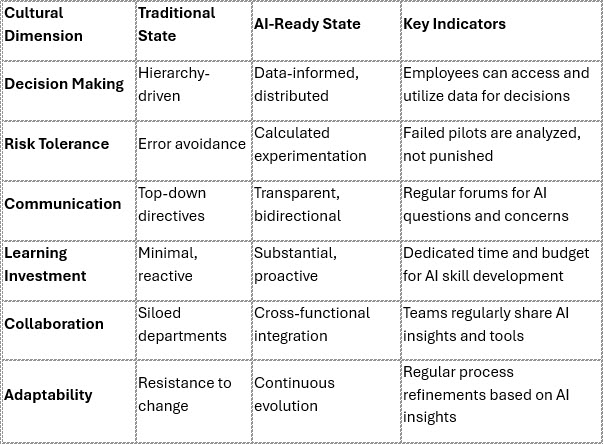
Change Management: Navigating the Human Side of AI Integration
While technology enables transformation, people ultimately determine its success or failure. Effective change management for AI requires understanding and addressing the full spectrum of human responses to this powerful technology.
Understanding Resistance: Signal, Not Obstacle
Resistance to AI adoption often manifests in predictable patterns: skepticism about capabilities, anxiety about job security, frustration with new workflows, or distrust of algorithmic decision-making. Rather than viewing resistance as an obstacle to overcome, sophisticated change leaders recognize it as valuable feedback revealing implementation blind spots.
Non-adopters frequently surface concerns that early enthusiasts overlook. Their skepticism can identify potential biases, highlight usability issues, or reveal misalignments between AI tools and actual workflow needs. When organizations engage these critical voices early and address their concerns authentically, former skeptics often become the most credible advocates.
Phased Implementation: The Strategic Advantage
Successful AI leaders pursue, on average, only half as many opportunities as their less advanced peers, focusing strategically on high-priority initiatives that can deliver meaningful value. This focused approach allows organizations to:
- Build expertise systematically rather than spreading resources too thin
- Generate early wins that build momentum and credibility
- Learn from each implementation before scaling
- Develop internal case studies that demonstrate value to skeptics
AI leaders expect more than twice the return on investment compared to other companies and successfully scale more than twice as many AI products and services across their organizations. Their success stems from following the “10-20-70 rule”: allocating approximately 10% of resources to algorithms, 20% to technology and data infrastructure, and 70% to people and processes.
Training and Development: Building AI Fluency at Scale
Effective AI training programs extend far beyond technical skills, encompassing three critical dimensions:
- Technical Literacy: Understanding what AI can and cannot do, how to interact with AI tools, and when to trust or question AI outputs
- Workflow Integration: Learning to redesign processes around AI capabilities rather than simply automating existing inefficient workflows
- Ethical Awareness: Developing sensitivity to bias, privacy implications, and the societal impacts of AI deployment
Organizations like Singtel demonstrate commitment to comprehensive upskilling by establishing AI acceleration academies that train thousands of employees across diverse roles, ensuring that AI literacy permeates the entire organization rather than remaining confined to technical specialists.
Extended Case Study: Manufacturing Transformation Journey
Consider a mid-sized manufacturing company facing increasing competitive pressure and rising operational costs. Their AI transformation journey illustrates the critical importance of cultural readiness and strategic change management.
Phase 1: Foundation Building (Months 1-4) The company began not with technology deployment but with cultural assessment and leadership alignment. Executive sponsors attended AI immersion sessions, visited organizations with mature AI implementations, and collaboratively developed a vision connecting AI adoption to strategic imperatives: improving quality, reducing waste, and enhancing worker safety.
Critically, they established a cross-functional AI steering committee including production workers, quality inspectors, and maintenance technicians, not just IT and management. This inclusion signaled that AI would be implemented with people, not imposed upon them.
Phase 2: Pilot and Learn (Months 5-9) Rather than attempting comprehensive deployment, the team selected three contained pilot projects:
- Predictive maintenance for critical equipment
- Quality inspection augmentation using computer vision
- Production scheduling optimization
Each pilot included embedded change champions from the affected departments who received intensive training and served as bridges between technical teams and frontline workers. These champions collected feedback, addressed concerns, and translated technical capabilities into practical applications.
Phase 3: Scale and Embed (Months 10-18) Success metrics extended beyond technical performance to include adoption rates, worker satisfaction, and process improvement ideas generated by employees. The company celebrated not just the 15% reduction in unplanned downtime but also the maintenance technician who suggested a novel application of the predictive model.
By the end of 18 months, the organization had transformed its relationship with technology. Workers who initially feared replacement by AI were now actively suggesting new applications and refinements. The cultural shift from technology as threat to technology as tool represented the true transformation.
Communication: The Continuous Thread
Throughout their journey, the company maintained multiple communication channels: monthly town halls addressing AI questions, weekly email updates celebrating both successes and learning moments, and an internal platform where employees could share AI experiences and suggestions. This communication strategy emphasized transparency, acknowledged concerns directly, and consistently reinforced how AI supported rather than replaced human judgment.
Governance and Policy: Creating Guardrails for Responsible Innovation
As AI capabilities expand, robust governance frameworks become essential for managing both opportunities and risks. Effective governance balances enabling innovation with ensuring responsible, ethical deployment.
Institutional Policy Framework
Comprehensive AI governance addresses several critical dimensions:
- Algorithmic Accountability: Establishing clear ownership for AI system performance, including processes for auditing decisions and addressing errors
- Data Stewardship: Defining roles and responsibilities for data quality, access controls, and lifecycle management
- Use Case Approval: Creating streamlined but thorough processes for evaluating and approving new AI applications
- Human-AI Collaboration: Clarifying when humans must remain in decision-making loops versus when automation is appropriate
These policies should be developed collaboratively, incorporating perspectives from legal, ethics, technical, and operational teams. They must balance comprehensiveness with practical usability—overly bureaucratic policies become obstacles that employees circumvent rather than follow.
Privacy, Security, and Ethics
Trust in AI systems depends on rigorous attention to privacy protection and security protocols. Organizations must implement technical safeguards including data encryption, access controls, and monitoring systems. Equally important are cultural practices that make privacy and security everyone’s responsibility, not just IT’s concern.
Ethical frameworks should address algorithmic bias proactively, establishing processes for evaluating training data, testing for discriminatory outcomes, and providing remediation mechanisms when bias is discovered. These frameworks acknowledge that perfect fairness may be impossible but commit to continuous improvement and transparency about limitations.
Living Governance: Monitoring and Evolution
AI governance cannot be static. Regular reviews should assess whether policies keep pace with technological capabilities, business needs, and societal expectations. Organizations should establish clear metrics for governance effectiveness, not just compliance rates but also indicators of whether governance enables responsible innovation or merely creates bureaucratic friction.
Sustainability: Engineering Long-Term Success
The initial excitement of AI implementation often gives way to the harder work of sustaining value over time. Organizations that maintain AI momentum share several characteristics.
Strategic Resource Allocation
Successful AI programs treat infrastructure investment as ongoing rather than one-time. This includes not just computational resources but also dedicated roles for AI governance, training program management, and continuous improvement facilitation. Organizations that view AI as a capability to nurture rather than a project to complete demonstrate significantly better long-term outcomes.
Cultivating Continuous Learning
As AI technologies evolve rapidly, yesterday’s cutting-edge knowledge becomes tomorrow’s baseline. Organizations must embed ongoing professional development into regular workflows, not as occasional training events but as continuous learning integrated into daily work. This might include regular lunch-and-learn sessions, internal AI communities of practice, or rotation programs that expose employees to diverse AI applications.
Innovation Pipeline: From Ideas to Impact
Rather than waiting for leadership to identify AI opportunities, mature organizations create systems for surfacing, evaluating, and rapidly testing AI ideas from throughout the organization. These innovation pipelines include lightweight processes for idea submission, quick evaluation criteria, and small-scale testing resources that allow promising concepts to be explored without major commitments.
Measuring and Communicating Impact
Sustained executive support and employee engagement require visible demonstrations of value. Effective measurement extends beyond immediate efficiency gains to include:
- Capability Enhancement: How AI enables previously impossible insights or actions
- Quality Improvements: Reduced errors, enhanced customer experiences, or better decision quality
- Employee Satisfaction: Whether AI makes work more engaging and meaningful
- Learning Acceleration: How quickly the organization identifies and scales successful AI applications
Regular communication of these outcomes, celebrating successes, sharing lessons from challenges, and maintaining transparency about ongoing efforts, sustains the cultural momentum essential for long-term success.
AI Maturity and Impact Model
┌─────────────────────────────────────────────────────────────┐
│ AI Organizational Maturity │
├─────────────────────────────────────────────────────────────┤
│ │
│ TRANSFORMATIVE ████████████████████ Culture of │
│ (36-48 months) █ Strategic █ continuous │
│ █ Integration █ innovation │
│ ████████████████████ │
│ ↑ │
│ │ │
│ SCALING ████████████████ Multiple use cases │
│ (18-36 months) █ Expanding █ deployed; governance │
│ █ Adoption █ frameworks mature │
│ ████████████████ │
│ ↑ │
│ │ │
│ PILOTING ██████████ Initial projects; learning │
│ (6-18 months) █ Learning █ from successes and failures │
│ ██████████ │
│ ↑ │
│ │ │
│ FOUNDATION ████████ Culture assessment; │
│ (0-6 months) █ Setup █ infrastructure preparation │
│ ████████ │
│ │
└─────────────────────────────────────────────────────────────┘
Key Success Factors at Each Stage:
– Foundation: Leadership alignment, psychological safety
– Piloting: Cross-functional engagement, rapid learning cycles
– Scaling: Governance frameworks, skill development programs
– Transformative: Innovation pipelines, distributed decision-making
Conclusion: Culture as Competitive Advantage
The organizations that thrive in an AI-augmented future will not be those with the most sophisticated algorithms or the largest computing budgets. They will be those that have cultivated cultures where humans and AI collaborate effectively, where experimentation is valued over perfection, where learning happens continuously, and where governance enables rather than constrains innovation.
Building such a culture requires patience, intentionality, and sustained commitment. It demands that leaders model the behaviors they wish to see, that organizations invest substantially in developing their people, and that success is measured not just in efficiency gains but in cultural transformation.
The journey toward an AI-ready culture is not a detour from the path to AI value, it is the path itself. Organizations that recognize this fundamental truth and commit to the hard work of cultural transformation will not only successfully implement AI technologies but will also develop the adaptive capabilities essential for navigating whatever technological revolutions lie ahead.
The question is not whether your organization will adopt AI, but whether you will build a culture that allows you to do so successfully. That work begins today, with honest assessment of your current culture, clear-eyed recognition of the gaps, and courageous commitment to the transformational journey ahead.
References
- Boston Consulting Group. (2024). AI Adoption in 2024: 74% of Companies Struggle to Achieve and Scale Value. Retrieved from https://www.bcg.com/press/24october2024-ai-adoption-in-2024-74-of-companies-struggle-to-achieve-and-scale-value
- Society for Human Resource Management. (2025). How Organizational Culture Shapes AI Adoption and Success: Q&A with Jessica Kriegel of Culture Partners. Retrieved from https://www.shrm.org/topics-tools/flagships/ai-hi/how-organizational-culture-shapes-ai-adoption-success
- Murire, O. T. (2024). Artificial Intelligence and Its Role in Shaping Organizational Work Practices and Culture. Administrative Sciences, 14(12), 316. Retrieved from https://www.mdpi.com/2076-3387/14/12/316
- McKinsey & Company. (2025). Reconfiguring Work: Change Management in the Age of Gen AI. Retrieved from https://www.mckinsey.com/capabilities/quantumblack/our-insights/reconfiguring-work-change-management-in-the-age-of-gen-ai
- IBM. (2025). Transforming Change Management with Responsible AI. Retrieved from https://www.ibm.com/think/insights/change-management-responsible-ai
Disclaimer: This article was created with the assistance of artificial intelligence tools. The views and opinions expressed are those of the author and do not necessarily reflect the official policy or position of any organization. The information provided is for general educational and informational purposes only and is not intended as, and should not be construed as, legal, financial, or professional advice. Readers should consult qualified professionals for advice specific to their circumstances. The author and publisher make no representations or warranties with respect to the accuracy or completeness of the contents and specifically disclaim any implied warranties. Neither the author nor the publisher shall be liable for any loss or damage arising from reliance on the information contained herein. Copyright © 2025. All rights reserved. This article is provided for educational and informational purposes. Organizations should consult with qualified professionals for specific guidance on AI implementation and change management strategies appropriate to their unique circumstances.
This image is an original, AI-assisted illustration created for educational commentary on AI culture and change management. It does not depict real people or proprietary systems. References to third parties (e.g., BCG, SHRM, McKinsey, IBM, MDPI) are citations only—no sponsorship or endorsement implied. All trademarks belong to their owners. © John Ho 2025. Licensed for this post only; no copying, redistribution, or AI/model-training use without written consent.
This article was written by Dr John Ho, a professor of management research at the World Certification Institute (WCI). He has more than 4 decades of experience in technology and business management and has authored 28 books. Prof Ho holds a doctorate degree in Business Administration from Fairfax University (USA), and an MBA from Brunel University (UK). He is a Fellow of the Association of Chartered Certified Accountants (ACCA) as well as the Chartered Institute of Management Accountants (CIMA, UK). He is also a World Certified Master Professional (WCMP) and a Fellow at the World Certification Institute (FWCI).
ABOUT WORLD CERTIFICATION INSTITUTE (WCI)

World Certification Institute (WCI) is a global certifying and accrediting body that grants credential awards to individuals as well as accredits courses of organizations.
During the late 90s, several business leaders and eminent professors in the developed economies gathered to discuss the impact of globalization on occupational competence. The ad-hoc group met in Vienna and discussed the need to establish a global organization to accredit the skills and experiences of the workforce, so that they can be globally recognized as being competent in a specified field. A Task Group was formed in October 1999 and comprised eminent professors from the United States, United Kingdom, Germany, France, Canada, Australia, Spain, Netherlands, Sweden, and Singapore.
World Certification Institute (WCI) was officially established at the start of the new millennium and was first registered in the United States in 2003. Today, its professional activities are coordinated through Authorized and Accredited Centers in America, Europe, Asia, Oceania and Africa.
For more information about the world body, please visit website at https://worldcertification.org.


