 World Certification Institute – WCI | Global Certification Body World Certification Institute (WCI) is a global certifying body that grants credential awards to individuals as well as accredits courses of organizations.

The New Reality of Supply Chain Vulnerability
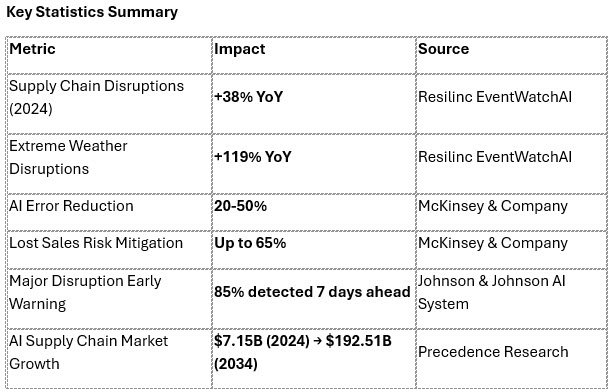
The fragility of global supply chains has never been more apparent. The COVID-19 pandemic, the Suez Canal blockage, and increasingly volatile weather patterns have exposed the brittle foundation upon which modern commerce rests. In 2024 alone, supply chain disruptions surged by 38% compared to the previous year, with extreme weather events jumping a dramatic 119%. Flood-related alerts increased by 214%, while hurricanes and typhoons rose by 101%, fundamentally reshaping how businesses must approach logistics planning.
Traditional Enterprise Resource Planning (ERP) systems excel at processing historical data, tracking what happened yesterday, last month, or last year. However, they fundamentally lack the capability to anticipate what will happen tomorrow. In an era where uncertainty has become the only certainty, this backward-looking approach leaves companies perpetually one step behind the next disruption.
The proposition is clear: By integrating artificial intelligence with ERP systems and predictive external signals from meteorological data to geopolitical intelligence, companies can fundamentally shift from reactive firefighting to proactive resilience. This transformation encompasses cost efficiency, supplier agility, weather-proof planning, and AI functioning as a real-time orchestration tool that operates with the foresight of a chess grandmaster rather than the hindsight of a historian.
The Costly Limitations of Traditional Supply Chain Management
Traditional supply chain management operates within significant constraints that become liability during disruptions. ERP systems, while powerful for inventory tracking and order processing, rely on static algorithms and historical patterns. They assume that tomorrow will resemble yesterday, an assumption that proves catastrophically wrong during hurricanes, port strikes, or sudden geopolitical shifts.
Manual decision-making buckles under the weight of modern complexity. Supply chain managers face an overwhelming matrix of variables: cost fluctuations, geographic dependencies, lead time variations, quality considerations, and disruption probabilities. The human brain, remarkable as it is, cannot simultaneously process thousands of data points from suppliers across dozens of countries while factoring in real-time weather patterns, political instability, and market demand shifts.
Single-source supplier relationships expose companies to concentrated risk. When a typhoon shuts down a critical manufacturing region, or when labor disputes paralyze a port, businesses dependent on singular supply routes face immediate operational paralysis. According to research from McKinsey, such disruptions can reduce supply chain errors, but only when predictive systems are in place, traditional reactive approaches simply amplify the damage.
The consequences cascade rapidly: inventory stockouts, production delays, expedited freight costs, customer dissatisfaction, and ultimately, revenue erosion. In today’s competitive landscape, a single major disruption can permanently damage customer relationships and market positioning.
AI: The Intelligence Layer Transforming ERP Systems
Artificial intelligence fundamentally transforms supply chain management by adding a predictive intelligence layer to traditional ERP infrastructure. Rather than replacing existing systems, AI augments them with capabilities that seem almost prophetic in their accuracy.
Modern AI systems continuously ingest data from multiple sources simultaneously: internal ERP databases, supplier performance metrics, logistics partner tracking systems, weather forecasting services, news feeds monitoring geopolitical events, and even social media signals indicating emerging market trends. This comprehensive data integration enables capabilities impossible for traditional systems.
AI excels at real-time pattern recognition across vast datasets. Where a human analyst might spend weeks analyzing historical shipping data to identify seasonal patterns, AI processes years of data in seconds, identifying not just obvious seasonal trends but subtle correlations between seemingly unrelated factors, how currency fluctuations in one region correlate with supplier reliability in another, or how political events affect transportation costs weeks later.
Predictive analytics powered by AI combine historical performance with external signals. Research indicates that AI can reduce supply chain errors by 20% to 50%, while mitigating the risk of lost sales and product unavailability by as much as 65%. When meteorological services forecast a typhoon approaching the South China Sea, AI doesn’t just note the information, it immediately calculates which suppliers, shipments, and production schedules face risk, then generates actionable recommendations.
Dynamic rerouting and supplier selection happen in real-time. Consider this scenario: AI detects an approaching storm that threatens a key supplier’s manufacturing region. Within milliseconds, it evaluates alternative suppliers, calculating their current capacity, quality ratings, lead times, and pricing. It identifies which supplier can absorb the order without quality compromise, calculates the cost differential, and presents the supply chain manager with a clear recommendation, complete with confidence scores and risk assessments.
Weather Intelligence: From Forecast to Foresight
The integration of meteorological data with supply chain management represents one of AI’s most powerful applications. Weather has always affected logistics, but AI transforms weather data from a general concern into precise, actionable intelligence.
When severe weather approaches a critical supply region, AI-powered systems provide early warning with remarkable specificity. Advanced systems have demonstrated the ability to identify 85% of major supply disruptions an average of seven days before impacts materialize. This lead time creates opportunities for intervention that simply didn’t exist with traditional approaches.
Real-World Weather-Driven Decision Making
Consider a practical scenario: meteorological services forecast a major storm system approaching the South China Sea, a region dense with manufacturing facilities. Traditional supply chain management might issue general warnings to teams, who then spend hours manually checking which suppliers might be affected, calling factories to assess their preparedness, and trying to determine if shipments should be expedited.
AI-powered systems operate differently. The moment weather models update with the storm’s projected path, AI cross-references this information against:
- Current supplier locations and their specific facility vulnerabilities
- In-transit shipments that may encounter delays
- Alternative suppliers in unaffected regions with available capacity
- Historical data on how similar weather events affected similar regions
- Lead time requirements for products currently in the affected pipeline
Within minutes, the system generates specific recommendations: reschedule certain shipments to depart before the storm arrives, reroute others through alternative ports, shift orders for products with longer lead times to inland suppliers with buffer stock, and prepare expedited freight options for time-critical items.
The strategic value extends beyond immediate crisis management. Companies using AI weather intelligence optimize shipping routes year-round, reducing unnecessary weather-related premiums. They schedule preventive inventory builds before seasonal weather patterns create predictable disruptions. They negotiate better terms with suppliers by demonstrating sophisticated risk management that protects both parties.
This proactive approach keeps operations running smoothly while competitors scramble to respond after disruptions occur, a competitive advantage that compounds over time.
Dynamic Supplier Networks: Beyond Static Hierarchies
Traditional supply chain management treats suppliers as relatively static relationships arranged in hierarchical tiers. Primary suppliers receive most orders, secondary suppliers serve as backups, and the hierarchy rarely shifts except during periodic reviews. This rigidity becomes liability when disruptions strike.
AI enables fundamentally different supplier relationship models based on dynamic capability matching. Rather than static hierarchies, AI creates flexible networks where supplier selection occurs continuously based on real-time performance metrics.
The system evaluates each supplier across multiple dimensions simultaneously: historical on-time delivery performance, current production capacity utilization, quality scores from recent shipments, financial stability indicators, geographic risk exposure, pricing competitiveness, and responsiveness to previous urgent requests. This multidimensional evaluation happens automatically and updates constantly.
When demand surges or disruptions occur, AI immediately identifies which suppliers possess buffer capacity to absorb additional orders without compromising quality or delivery reliability. It calculates not just who can fulfill an order, but who can fulfill it best considering all relevant factors at that specific moment.
This capability transforms supply chains from fixed routes into adaptive ecosystems. A supplier experiencing temporary capacity constraints automatically receives fewer orders until their situation improves. A supplier consistently exceeding performance expectations gradually receives more business. Geographic risks get dynamically balanced, when political instability affects one region, orders automatically flow toward more stable alternatives.
The result is a self-optimizing network that continuously evolves toward better performance, reduced risk, and improved cost efficiency without requiring constant manual intervention.
AI as Your Tireless Chief Supply Chain Officer
Perhaps AI’s most transformative role is serving as a tireless orchestration engine, essentially functioning as your Chief Supply Chain Officer that never sleeps, never overlooks details, and processes information with superhuman speed and comprehension.
Continuous Risk Monitoring and Management
AI systems monitor thousands of risk signals simultaneously, 24 hours daily. They track weather systems globally, monitor news feeds for labor disputes or political events, analyze financial indicators signaling supplier distress, observe transportation network congestion, and detect anomalies in supplier communication patterns that might indicate emerging problems.
This continuous vigilance enables proactive intervention. When early warning signals appear, a supplier’s financial metrics deteriorating, a potential labor dispute at a critical port, unusual weather patterns developing, AI flags these concerns immediately, often days or weeks before they manifest as actual disruptions.
Intelligent Order Management
AI doesn’t just track orders; it actively manages them based on strategic priorities. It evaluates each order against multiple factors: customer profitability, contract requirements, inventory levels, supplier reliability, and competitive implications. For high-value customers or time-sensitive orders, AI automatically prioritizes resources and may recommend expedited options. For lower-margin orders, it optimizes for cost efficiency while maintaining acceptable service levels.
Learning from Experience
Perhaps most powerfully, AI learns from previous disruptions. It remembers which suppliers underperformed during last year’s typhoon season, which backup plans worked effectively during port strikes, and which customers tolerated delays versus those who immediately sought alternative vendors. This institutional memory never fades, never takes vacation, and continuously informs better future decisions.
The system manages complex trade-offs that traditionally required executive judgment: balancing just-in-time inventory efficiency against just-in-case disruption preparedness, weighing freight cost inflation against customer satisfaction impacts, and determining when to accept higher costs to maintain strategic relationships.
Profitability Optimization: Strategic Value Creation
AI transforms supply chain management from a cost center into a profit optimization engine. By simultaneously considering customer value, operational costs, and strategic positioning, AI enables nuanced decision-making that maximizes financial outcomes.
Customer Segmentation and Service Differentiation
AI analyzes customer profitability across multiple dimensions: revenue contribution, payment reliability, growth potential, strategic importance, and price sensitivity. This analysis enables intelligent service differentiation.
For high-value customers, those contributing disproportionate revenue or possessing significant growth potential, AI may recommend premium service options even when they incur higher costs. Perhaps this means routing their orders through more expensive but more reliable carriers, maintaining deeper safety stock for their preferred products, or expediting shipments during supply constraints.
Conversely, for lower-margin customers who demonstrate high price sensitivity, AI optimizes for cost efficiency. It routes orders through the most economical channels, suggests standard delivery timelines that optimize carrier consolidation, and recommends product alternatives when preferred items face supply constraints.
Dynamic Pricing Intelligence
AI identifies pricing opportunities based on real-time supply-demand dynamics. When supply constraints emerge, it calculates pricing elasticity, determining which customers or product categories can absorb price increases with minimal demand impact. When excess capacity exists, it identifies strategic opportunities for volume growth through temporary pricing incentives.
This capability ensures that every supply chain decision considers financial implications, transforming logistics from operational necessity into strategic advantage.
The CLEAR Framework™: Your Implementation Roadmap
Implementing AI-driven supply chain transformation requires structured approach. The CLEAR Framework™ provides a systematic methodology:
Connected ERP + AI Infrastructure Integrate AI capabilities with existing ERP systems rather than replacing them. Establish data pipelines connecting internal systems with external intelligence sources.
Leverage Predictive Signals Incorporate weather forecasting, geopolitical monitoring, financial indicators, and market intelligence. Create feedback loops that continuously improve predictive accuracy.
Evaluate Dynamic Supplier Options Move beyond static supplier hierarchies to flexible networks. Implement continuous performance monitoring and automated capability matching.
Act Proactively with Scenario Planning Develop contingency plans for various disruption scenarios. Use AI to simulate different approaches and identify optimal responses before crises occur.
Refine Continuously with Machine Learning Establish feedback mechanisms that capture outcomes from decisions. Enable systems to learn from both successes and failures, continuously improving performance.
This framework scales from mid-sized companies seeking competitive advantage to global enterprises requiring sophisticated risk management across complex networks. The key is beginning the journey, even partial implementation delivers measurable benefits.
The Competitive Imperative: Leading Proactively in 2025 and Beyond
Traditional supply chains are breaking under the weight of modern complexity and disruption frequency. Research projects that by 2030, 50% of cross-functional supply chain management solutions will use intelligent agents to autonomously execute decisions. The AI supply chain market is expected to surge from $7.15 billion in 2024 to $192.51 billion by 2034, reflecting the urgent need for these capabilities.
Companies that continue relying on reactive, manual approaches will find themselves increasingly disadvantaged. Each disruption they struggle through becomes an opportunity for AI-enabled competitors to capture market share, strengthen customer relationships, and improve operational efficiency.
AI doesn’t just incrementally improve supply chain management, it fundamentally transforms it. The technology enables capabilities that were simply impossible before: predicting disruptions days before they occur, dynamically optimizing across thousands of variables simultaneously, learning from experience at inhuman scale and speed, and operating with tireless vigilance that human teams cannot match.
The question facing business leaders is not whether AI will transform supply chain management, that transformation is already underway. The question is whether your organization will lead this transformation or struggle to catch up after competitors have established insurmountable advantages.
Leadership today demands agility, foresight, and the wisdom to embrace technology that multiplies human capability rather than fearing it. The sooner your business integrates AI into ERP and supply chain management, the faster you future-proof against uncertainty while positioning for growth.
Discussion Questions
- How is your organization currently leveraging AI in supply chain resilience?
- What barriers, technical, cultural, or financial are preventing fuller implementation?
- Where do you see the greatest opportunities for AI to transform your supply chain operations?
The storm is coming. The only question is whether you’ll be scrambling to respond or confidently executing plans you made weeks ago.
References:
- Resilinc EventWatchAI – For the 2024 supply chain disruptions (+38% YoY) and extreme weather events (+119% YoY, with specifics on floods +214% and hurricanes/typhoons +101%).
- McKinsey & Company – For AI reducing supply chain errors by 20-50% and mitigating lost sales risk by up to 65%.
- Johnson & Johnson AI System – For detecting 85% of major supply disruptions an average of 7 days ahead.
- Precedence Research – For the AI supply chain market growth from $7.15B in 2024 to $192.51B by 2034 (note: recent updates from the source list it as starting from $9.94B in 2025, but the core projection aligns).
- Gartner – For the projection that by 2030, 50% of cross-functional supply chain management solutions will use intelligent agents.
Image Disclaimer — World Certified Institute This image was created with AI-assisted tools for illustrative and educational purposes. It does not depict real persons, places, or events. Any trademarks or logos are the property of their respective owners and are referenced nominatively without endorsement. © 2025 World Certified Institute. All rights reserved. Reuse requires prior written permission.
This article was written with AI-assisted tools and complies with copyright, trademark, and privacy standards. All insights are original and evidence-based, drawing on publicly available research and industry reports. The CLEAR Framework™ is presented as an educational concept for implementing AI-driven supply chain strategies.
Disclaimer: This article is provided for informational and educational purposes only and does not constitute professional, legal, financial, or business advice. The author, publisher, and World Certified Institute disclaim any liability for any loss, damage, or other consequences arising from the use of or reliance on the information contained herein. Readers are encouraged to consult qualified professionals for specific advice tailored to their circumstances. This article was created with the assistance of AI tools to enhance research and writing efficiency.
This article was written by Dr John Ho, a professor of management research at the World Certification Institute (WCI). He has more than 4 decades of experience in technology and business management and has authored 28 books. Prof Ho holds a doctorate degree in Business Administration from Fairfax University (USA), and an MBA from Brunel University (UK). He is a Fellow of the Association of Chartered Certified Accountants (ACCA) as well as the Chartered Institute of Management Accountants (CIMA, UK). He is also a World Certified Master Professional (WCMP) and a Fellow at the World Certification Institute (FWCI).
ABOUT WORLD CERTIFICATION INSTITUTE (WCI)

World Certification Institute (WCI) is a global certifying and accrediting body that grants credential awards to individuals as well as accredits courses of organizations.
During the late 90s, several business leaders and eminent professors in the developed economies gathered to discuss the impact of globalization on occupational competence. The ad-hoc group met in Vienna and discussed the need to establish a global organization to accredit the skills and experiences of the workforce, so that they can be globally recognized as being competent in a specified field. A Task Group was formed in October 1999 and comprised eminent professors from the United States, United Kingdom, Germany, France, Canada, Australia, Spain, Netherlands, Sweden, and Singapore.
World Certification Institute (WCI) was officially established at the start of the new millennium and was first registered in the United States in 2003. Today, its professional activities are coordinated through Authorized and Accredited Centers in America, Europe, Asia, Oceania and Africa.
For more information about the world body, please visit website at https://worldcertification.org.


