 World Certification Institute – WCI | Global Certification Body World Certification Institute (WCI) is a global certifying body that grants credential awards to individuals as well as accredits courses of organizations.

In the ever-evolving world of technology, we find ourselves at a pivotal moment where the boundaries of what’s possible are being redrawn. Picture a bustling data center, humming with the energy of countless servers processing AI algorithms that power everything from personalized recommendations on your streaming service to life-saving medical diagnostics. Yet, beneath this digital symphony lies a growing crisis: the insatiable hunger for power and the physical limits of traditional silicon chips. Enter photonic chips, a technology that swaps electrons for photons, promising to accelerate computing while slashing energy use. While quantum computing captures imaginations with its otherworldly potential, photonic systems are poised to deliver real-world transformations much sooner, acting as a practical bridge to a more efficient digital era.
This isn’t just about faster gadgets; it’s about reimagining how we interact with information in a way that feels almost poetic. Think of light not as something that merely illuminates a room, but as the very medium carrying our data dreams. Photonic computing harnesses beams of light to process information, offering a glimpse into a future where technology aligns more harmoniously with our planet’s resources. As we delve deeper, we’ll explore how this innovation stacks up against quantum alternatives, why it matters for our energy-strapped world, and what it means for the innovators and everyday users alike.
At its core, photonic computing is an elegant fusion of physics and engineering. Traditional computers rely on electrical signals zipping through silicon pathways, but these electrons bump into resistance, generating heat and slowing down as circuits shrink. Photons, on the other hand, travel at the speed of light about 300,000 kilometers per second without the same frictional losses. This shift allows photonic chips to handle data with unprecedented velocity and minimal energy waste. By using light’s properties, such as wavelength division multiplexing, these chips can transmit multiple data streams simultaneously on different colors of light, much like a prism separating a rainbow into distinct bands, each carrying its own information load.
Recent breakthroughs underscore this potential. For instance, innovative photonic processors have demonstrated the ability to perform complex AI computations in under half a nanosecond, achieving accuracy rates above 92% in inference tasks. More strikingly, certain light-based chips offer up to 50 times the computing speed of conventional silicon while improving energy efficiency by a factor of 30. This isn’t science fiction; it’s the result of materials like thin-film lithium niobate enabling ultra-fast optical signal manipulation without the heat buildup that plagues electronic counterparts.
What makes photonics particularly inspiring is its human touch, it is not about discarding the old but enhancing it. These systems can seamlessly integrate with existing electronic infrastructures, creating hybrid setups that boost bandwidth and performance. Imagine an engineer in a lab, tweaking a photonic circuit that slots right into a standard server rack, instantly amplifying its capabilities without a full overhaul. This compatibility lowers barriers to adoption, making high-speed, low-power computing accessible to industries from telecommunications to healthcare. In a world where innovation often feels disruptive and overwhelming, photonics offers a gentle evolution, empowering creators to build on what they know while pushing boundaries.
Contrast this with quantum computing, a field that evokes the thrill of exploring uncharted territories. Quantum systems leverage qubits, which can occupy multiple states at once thanks to superposition and entanglement, allowing them to solve problems like optimizing vast supply chains or simulating molecular interactions that would stump even the most powerful supercomputers today. The allure is undeniable: cracking codes that secure our online lives or accelerating drug discovery to combat diseases faster.
Yet, the journey to viable quantum tech is fraught with challenges that feel almost mythical in their complexity. Qubits are delicate, demanding cryogenic temperatures near absolute zero to maintain stability, and even then, errors creep in due to environmental noise. Scaling up while preserving coherence remains a Herculean task. Industry analyses project that truly practical quantum applications, such as advanced chemistry simulations, might not materialize until around 2033 to 2040. In the meantime, the sector is buzzing with activity; quantum companies raked in $650 million to $750 million in revenue in 2024, largely from research and pilot projects, and are on track to surpass $1 billion in 2025. This growth is heartening, fueled by investments topping $2 billion in startups last year, but it highlights quantum’s current stage: more promise than practice.
As we grapple with these technologies, a pressing human concern emerges, the environmental toll of our digital appetites. Data centers, the unsung heroes of the cloud era, now devour up to 3% of global electricity, a figure set to climb with AI’s rise. This isn’t just a statistic; it’s the story of communities burdened by higher energy costs and the planet straining under carbon emissions. Photonic chips address this head-on by slashing power needs, offering efficiencies 10 to 100 times better than silicon for similar tasks. Without the heat waste of electrical resistance, they reduce the need for energy-guzzling cooling systems, making computing leaner and greener.
Humanizing this, consider a data scientist training AI models for climate prediction. With photonic tech, she could run simulations faster and with less environmental guilt, turning data into actionable insights that help mitigate the very crises computing exacerbates. This synergy between performance and sustainability inspires a sense of hope, reminding us that technology can be a force for good when designed thoughtfully.
To visualize the contrasts, let’s examine a side-by-side comparison:
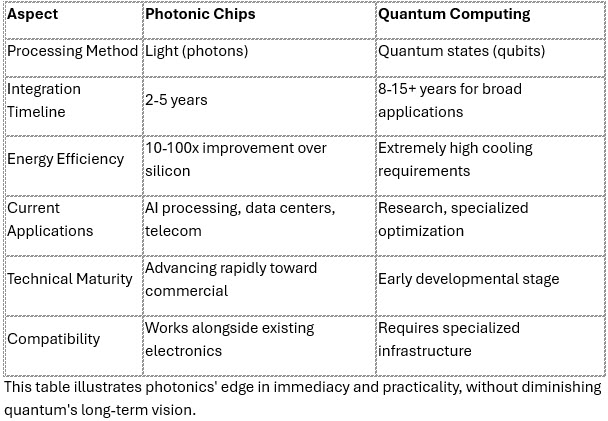
Indeed, when pondering which will reshape computing first, photonic chips emerge as the clear frontrunner. Their market is booming, projected to expand from $17.36 billion in 2025 to $65.69 billion by 2032, driven by demands for faster, more efficient systems in AI and beyond. This isn’t hype; it’s backed by real momentum, with companies investing in scalable production. Photonics solves today’s bottlenecks like AI’s power drain, while paving the way for hybrid futures where quantum might one day integrate.
Looking ahead, both technologies embody human ingenuity at its finest. Quantum will unlock mysteries, from new materials to personalized medicine, but photonics lights the immediate path, making our world faster and more sustainable. It’s a reminder that progress isn’t always about radical leaps; sometimes, it’s the steady glow of incremental brilliance that guides us forward.
In this photonic dawn, we see not just circuits and code, but a harmonious blend of speed, efficiency, and responsibility. As innovators, entrepreneurs, and everyday dreamers, we’re invited to embrace this light, crafting a future where technology elevates humanity without costing the earth. The revolution is here, and it’s brilliantly illuminated.
References
- MIT News – Photonic Processor Technology (2024): https://news.mit.edu/2024/photonic-processor-could-enable-ultrafast-ai-computations-1202
- Fortune Business Insights – Photonic Integrated Circuit Market (2025): https://www.fortunebusinessinsights.com/photonic-integrated-circuit-market-107051
- McKinsey & Company – The Year of Quantum (2025): https://www.mckinsey.com/capabilities/mckinsey-digital/our-insights/the-year-of-quantum-from-concept-to-reality-in-2025
- Introduction to Quantum Computing – Timeline Analysis (2025): https://introtoquantum.org/essentials/timelines/
- Interesting Engineering – Photonic Chip Speed Comparison (2025): https://interestingengineering.com/innovation/world-first-light-based-chip
Disclaimer
This article was assisted by AI technology and is intended for informational and educational purposes only. All information presented is based on publicly available sources as of September 2025 and has been paraphrased to ensure originality. The author makes no representations or warranties of any kind, express or implied, about the completeness, accuracy, reliability, suitability, or availability of the information contained herein. Any reliance placed on such information is strictly at the reader’s own risk. The author disclaims all liability for any loss or damage, including without limitation indirect or consequential loss or damage, arising from the use of this article. Readers are encouraged to verify facts independently through the referenced sources or other reliable means. No trademarks, copyrights, or privacy rights have been intentionally infringed, and all content complies with applicable laws.
This article was written by Dr John Ho, a professor of management research at the World Certification Institute (WCI). He has more than 4 decades of experience in technology and business management and has authored 28 books. Prof Ho holds a doctorate degree in Business Administration from Fairfax University (USA), and an MBA from Brunel University (UK). He is a Fellow of the Association of Chartered Certified Accountants (ACCA) as well as the Chartered Institute of Management Accountants (CIMA, UK). He is also a World Certified Master Professional (WCMP) and a Fellow at the World Certification Institute (FWCI).
ABOUT WORLD CERTIFICATION INSTITUTE (WCI)

World Certification Institute (WCI) is a global certifying and accrediting body that grants credential awards to individuals as well as accredits courses of organizations.
During the late 90s, several business leaders and eminent professors in the developed economies gathered to discuss the impact of globalization on occupational competence. The ad-hoc group met in Vienna and discussed the need to establish a global organization to accredit the skills and experiences of the workforce, so that they can be globally recognized as being competent in a specified field. A Task Group was formed in October 1999 and comprised eminent professors from the United States, United Kingdom, Germany, France, Canada, Australia, Spain, Netherlands, Sweden, and Singapore.
World Certification Institute (WCI) was officially established at the start of the new millennium and was first registered in the United States in 2003. Today, its professional activities are coordinated through Authorized and Accredited Centers in America, Europe, Asia, Oceania and Africa.
For more information about the world body, please visit website at https://worldcertification.org.


