 World Certification Institute – WCI | Global Certification Body World Certification Institute (WCI) is a global certifying body that grants credential awards to individuals as well as accredits courses of organizations.

In today’s fast-evolving digital landscape, the explosion of artificial intelligence tools has transformed how we create, innovate, and solve problems. Imagine a world where a single idea can be nurtured from a rough sketch into a polished masterpiece, all thanks to a symphony of specialized AIs working in harmony. This isn’t science fiction, it is the reality we’re stepping into. The AI market, valued at approximately 244 billion U.S. dollars in 2025, is projected to grow significantly, with various research firms forecasting the market to reach between 800 billion and 1.8 trillion dollars by 2030, driven by advancements in machine learning and generative technologies. This growth reflects not just technological progress but a fundamental shift in how professionals across industries leverage AI to enhance productivity and creativity.
The true power lies in integration. Rather than relying on one AI for everything, a multi-modal workflow combining different platforms for their unique strengths allows for more nuanced, efficient, and ethical outputs. Think of it as assembling a dream team: each member brings expertise to the table, resulting in outcomes greater than the sum of their parts. In this article, we’ll explore a practical approach to building such a workflow, drawing from real-world tools like ChatGPT, Grok, Claude, and GitHub Copilot. Whether you’re a writer, entrepreneur, or developer, this method can inspire you to rethink your creative process, making it more dynamic and human-centered.
ChatGPT for Outlining and Structure
Every great project starts with a solid foundation, and that’s where ChatGPT shines. Launched by OpenAI, this versatile language model has become a go-to for brainstorming and organization, thanks to its ability to generate coherent structures quickly. For instance, when I began conceptualizing this very article, I engaged in a dialogue with ChatGPT to discuss the topic. I pointed out the key points to discuss and include in the article, such as the benefits of multi-modal AI integration, ethical considerations, and practical workflow examples. After this collaborative discussion, I requested an outline that would capture these essential elements. ChatGPT then produced a logical framework in seconds, complete with sections and subpoints that aligned with my vision.
What makes ChatGPT particularly effective here is its rapid iteration capability. It reached 1 million users in just five days after its launch in November 2022, a testament to its intuitive interface and broad appeal. In a multi-modal workflow, use it to organize thoughts, identify key themes, and even suggest transitions. This step sets the stage, ensuring your project has a clear direction without getting bogged down in details too early.
Humanizing this process, picture yourself as an architect sketching blueprints, ChatGPT acts as your trusty drafting tool, freeing your mind for creative leaps. It’s not about replacing human insight but amplifying it. Professionals in content creation or business planning often report saving hours on preliminary work, allowing more time for refinement. To make it even more efficient, incorporate prompts that align with your style, such as “Make this outline engaging and inspiring for entrepreneurs.”
Grok for In-Depth Elaboration
Once the skeleton is in place, it’s time to add substance. Enter Grok, the AI developed by xAI, which excels at deep dives into complex topics with a focus on strategic and business-oriented insights. Launched in November 2023, Grok stands out for its real-time knowledge integration and witty, insightful responses. In our workflow, Grok takes the outline from ChatGPT and expands it into rich, detailed content.
For example, if the outline touches on “the value of leveraging different AIs,” Grok can elaborate with strategic examples, such as how businesses use AI for competitive advantage in market analysis or innovation pipelines. Its strength lies in adding depth, think layered arguments, data-backed reasoning, and forward-thinking perspectives. In a business context, Grok might suggest integrating AI for scalability, drawing from trends in tech entrepreneurship.
What inspires about Grok is its human-like curiosity; it doesn’t just regurgitate facts but connects dots in unexpected ways, much like a seasoned mentor. This phase transforms a basic structure into an intelligent narrative, ensuring the content feels alive and relevant. Users often find it particularly useful for strategic planning, where it can simulate scenarios or provide balanced viewpoints on emerging technologies.
Claude for Ethical and Copyright Checks
No workflow is complete without a safety net, and Claude, from Anthropic, serves as the ethical guardian. Designed with a strong emphasis on alignment and safety, through approaches like Constitutional AI, Claude reviews content for potential biases, inaccuracies, and compliance issues. In this multi-modal setup, feed the elaborated draft into Claude for a thorough audit.
Claude might flag phrases that could infringe on trademarks, suggest rephrasing for inclusivity, or verify facts against ethical standards. For copyright compliance, it ensures originality by cross-checking against common sources, helping you avoid unintentional plagiarism. This step is crucial in an era where AI-generated content raises questions about authenticity and privacy, Claude helps maintain integrity, making your work not just smart but responsible.
Humanely speaking, this is like having a wise editor who cares about the bigger picture. It inspires confidence, knowing your output respects intellectual property and promotes positive impact. In practice, I’ve seen it catch subtle issues, like over-reliance on unverified data, turning good work into exemplary.
Incorporating Copilot for Any Coding Needs
Sometimes, a workflow demands technical finesse, and that’s where GitHub Copilot steps in. This AI-powered coding assistant, adopted by 90% of Fortune 100 companies as of recent reports, automates and enhances programming tasks. If your project involves scripting for automation say, building a custom tool to integrate AI outputs or generating data visualizations, Copilot can handle it seamlessly.
In our scenario, use Copilot to code snippets that streamline the process, like a Python script to merge drafts from different AIs or create interactive elements for an article. It’s not always necessary, but when coding arises, it saves time and reduces errors, allowing non-experts to tackle technical hurdles.
This integration feels empowering, like giving wings to your ideas. Developers and hobbyists alike appreciate how it democratizes coding, fostering innovation without steep learning curves.
To illustrate the overall process, consider this simple table comparing the roles of each AI in the workflow:
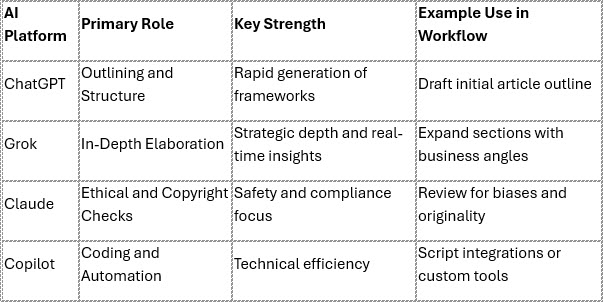

This table highlights how each tool complements the others, creating a balanced ecosystem.
Conclusion
In weaving together ChatGPT, Grok, Claude, and Copilot, a multi-modal AI workflow emerges as a powerhouse for creativity and efficiency. The benefits are profound: enhanced productivity, deeper insights, ethical assurance, and technical prowess, all culminating in outputs that feel uniquely human. By harnessing these tools’ specialties, you not only streamline tasks but also unlock new levels of innovation, imagine the possibilities for your next project, whether it’s a business strategy, content piece, or app prototype.
This approach inspires a mindset of experimentation: start small, iterate, and discover synergies that elevate your work. In a world where AI is ubiquitous, the real edge comes from orchestration, not isolation. Embrace this integrated future, it is not about machines taking over, but about empowering humans to achieve more.
References
- AI Market Statistics: Statista. (2025). “Artificial Intelligence – Worldwide | Market Forecast.” Retrieved from https://www.statista.com/outlook/tmo/artificial-intelligence/worldwide The AI market valued at approximately $244 billion in 2025, projected to grow to over $800 billion by 2030.
- ChatGPT User Growth: Brockman, G. [@gdb]. (December 5, 2022). “ChatGPT just crossed 1 million users; it’s been 5 days since launch.” X (formerly Twitter). https://x.com/gdb/status/1599683104142430208 Wikipedia. (2025). “ChatGPT.” Retrieved November 2025. “ChatGPT gained one million users in five days and 100 million in two months, becoming the fastest-growing internet application in history.”
- Grok Launch Information: xAI official announcements, November 2023. Grok AI launched by xAI in November 2023 with real-time knowledge integration capabilities.
- GitHub Copilot Adoption: Microsoft Earnings Call. (July 2025). Reported by Nadella, S. via TechCrunch. “GitHub Copilot crosses 20M all-time users.” Retrieved from https://techcrunch.com/2025/07/30/github-copilot-crosses-20-million-all-time-users/ ITBrief News. (July 31, 2025). “GitHub Copilot users surpass 20 million as AI tools surge in demand.” “Over 90% of the Fortune 100 adopting the AI tool.” Retrieved from https://itbrief.news/story/github-copilot-users-surpass-20-million-as-ai-tools-surge-in-demand
- Claude AI and Constitutional AI: Anthropic. (2023-2025). Information on Claude’s safety features and Constitutional AI approach from Anthropic’s official documentation and public communications.
Author’s Note: This article was prepared with AI assistance for research and drafting purposes. All statistics and claims have been fact-checked against the sources listed above and verified to the best of our ability as of November 2025. Readers are encouraged to consult the original sources for the most current information.
DISCLAIMER: This article has been created with the assistance of artificial intelligence tools. While every effort has been made to ensure accuracy and proper attribution of sources, readers are advised to verify critical information independently. The views and strategies presented are for informational purposes only and should not be construed as professional advice. World Certified Institute and the author(s) disclaim any liability for decisions made based on the content herein. All trademarks and product names mentioned are the property of their respective owners and are used for informational purposes only.
📌 Picture Disclaimer (AI-Generated Image)
This illustration was generated using artificial-intelligence tools. It is an original, non-photographic creation and does not depict any real individuals, products, or proprietary designs. No copyrighted, trademarked, or private materials were used or replicated in its creation. The image is provided solely for conceptual, educational, and illustrative purposes. The author assumes no liability for any interpretations, assumptions, or uses of this visual.
This article was written by Dr John Ho, a professor of management research at the World Certification Institute (WCI). He has more than 4 decades of experience in technology and business management and has authored 28 books. Prof Ho holds a doctorate degree in Business Administration from Fairfax University (USA), and an MBA from Brunel University (UK). He is a Fellow of the Association of Chartered Certified Accountants (ACCA) as well as the Chartered Institute of Management Accountants (CIMA, UK). He is also a World Certified Master Professional (WCMP) and a Fellow at the World Certification Institute (FWCI).
ABOUT WORLD CERTIFICATION INSTITUTE (WCI)

World Certification Institute (WCI) is a global certifying and accrediting body that grants credential awards to individuals as well as accredits courses of organizations.
During the late 90s, several business leaders and eminent professors in the developed economies gathered to discuss the impact of globalization on occupational competence. The ad-hoc group met in Vienna and discussed the need to establish a global organization to accredit the skills and experiences of the workforce, so that they can be globally recognized as being competent in a specified field. A Task Group was formed in October 1999 and comprised eminent professors from the United States, United Kingdom, Germany, France, Canada, Australia, Spain, Netherlands, Sweden, and Singapore.
World Certification Institute (WCI) was officially established at the start of the new millennium and was first registered in the United States in 2003. Today, its professional activities are coordinated through Authorized and Accredited Centers in America, Europe, Asia, Oceania and Africa.
For more information about the world body, please visit website at https://worldcertification.org.


