 World Certification Institute – WCI | Global Certification Body World Certification Institute (WCI) is a global certifying body that grants credential awards to individuals as well as accredits courses of organizations.

The workplace transformation we’re witnessing today isn’t just another technological shift, it is a fundamental reimagining of how work gets done. Artificial Intelligence has moved from the realm of science fiction into the daily operations of businesses worldwide, fundamentally altering the landscape of employment, skills, and career development. As we navigate this unprecedented change, one truth emerges clearly: our traditional approaches to workforce training are not just inadequate, they are becoming obstacles to progress.
The Velocity of Change: Understanding AI’s Immediate Impact
The statistics paint a startling picture of transformation. Recent McKinsey Global Institute research indicates that rapid advancements in generative artificial intelligence could see about 30% of Americans’ hours worked automated by 2030. This isn’t a distant possibility, it is happening now, with profound implications for how we prepare the workforce of tomorrow.
The scope of this disruption extends far beyond manufacturing or routine tasks. The automation potential for STEM professionals has jumped from 14% to 30% of work hours by 2030, affecting roles once considered immune to technological displacement. Creative professionals, business analysts, and even legal experts are finding their workflows increasingly augmented or replaced by intelligent systems.
What makes this transformation particularly challenging is its speed. Unlike previous technological revolutions that unfolded over decades, AI adoption is occurring at an unprecedented pace. Companies that once spent years implementing new systems are now deploying AI tools within months, creating an immediate demand for workers who can collaborate effectively with these technologies.
The Entry-Level Employment Crisis
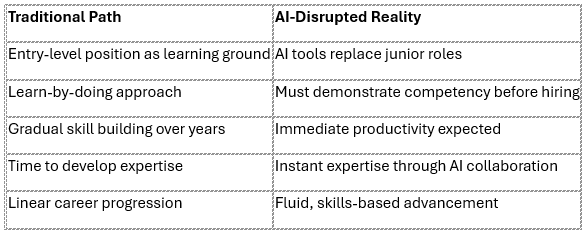
Perhaps nowhere is the impact more pronounced than in entry-level positions. These roles, traditionally serving as training grounds for new graduates, are rapidly being absorbed by AI systems that can perform many foundational tasks with greater speed and consistency than human newcomers.
The implications extend beyond individual careers to the entire learning ecosystem. When junior roles disappear, so does the traditional pathway for skill development. New graduates face a paradox: they need experience to get jobs, but the jobs that provide experience are vanishing. This creates a critical gap between academic preparation and workplace readiness.
Traditional vs. AI-Disrupted Career Progression
The Skills Revolution: What Today’s Workforce Needs
According to the World Economic Forum’s latest research, 85% of employers surveyed plan to prioritize upskilling their workforce, with 70% expecting to hire staff with new skills. This massive reskilling initiative represents one of the largest human capital transformations in modern history.
The skills gap isn’t just about technical competencies, it is about fundamental approaches to work. Traditional educational models emphasized knowledge retention and theoretical understanding. Today’s workplace demands adaptive thinking, AI collaboration, and the ability to leverage intelligent tools for enhanced productivity.
Critical Skills for the AI Era
Technical Fluency
- Understanding AI capabilities and limitations
- Proficiency with AI-powered business tools
- Data interpretation and analysis skills
- Digital collaboration platforms
Human-Centric Capabilities
- Complex problem-solving and strategic thinking
- Emotional intelligence and leadership
- Creative innovation and ideation
- Ethical decision-making in AI contexts
Adaptive Competencies
- Continuous learning mindset
- Cross-functional collaboration
- Change management
- Systems thinking
Rethinking Educational Paradigms
The mismatch between academic preparation and workplace reality has reached a critical point. While universities continue to focus on theoretical foundations, employers desperately need workers who can immediately contribute to AI-enhanced teams. This disconnect isn’t just inefficient, it is creating a generation of graduates who are simultaneously over-educated and under-prepared.
From Theory to Application: A New Learning Model
Experiential Learning Platforms Modern training must center on hands-on experience with real business scenarios. Students need access to simulated environments where they can practice making decisions with AI support, analyzing complex datasets, and managing automated processes.
Tool Integration Just as computer literacy became essential in previous decades, AI fluency must now be considered a basic requirement. This means incorporating AI tools directly into curriculum design, not as separate subjects but as integral components of every business discipline.
Outcome-Driven Assessment The question shouldn’t be whether students can recall information, but whether they can produce results. Can they analyze market data using AI-powered analytics? Can they develop strategic recommendations by leveraging machine learning insights? These practical competencies should drive educational design.
The Collaborative Future: Humans and AI as Partners
The most successful organizations aren’t replacing humans with AI, they are creating powerful partnerships between human intelligence and artificial capabilities. This collaboration requires a new kind of workforce: professionals who understand how to leverage AI while providing the uniquely human insights that machines cannot replicate.
Key Areas of Human-AI Collaboration
Strategic Decision Making AI excels at processing vast amounts of data and identifying patterns, but humans provide context, intuition, and ethical considerations that guide strategic choices.
Creative Problem Solving While AI can generate numerous options and solutions, human creativity shapes these possibilities into innovative approaches that resonate with real-world needs.
Relationship Management Despite advances in natural language processing, human empathy, cultural understanding, and emotional intelligence remain irreplaceable in client relations and team leadership.
Building Tomorrow’s Training Infrastructure
Creating an AI-ready workforce requires unprecedented collaboration between educational institutions, employers, and technology providers. Traditional boundaries between academic learning and professional development must dissolve in favor of integrated, continuous development pathways.
Essential Components of Next-Generation Training
Industry-Academic Partnerships Universities must work directly with leading companies to understand real-time skill requirements and provide students with access to current industry tools and challenges.
Continuous Learning Platforms The concept of graduation must evolve. Instead of completing education and entering the workforce, professionals need ongoing access to skill development that keeps pace with technological advancement.
Practical Application Environments Training programs need sophisticated simulation environments where learners can practice with real business scenarios, AI tools, and complex decision-making challenges without real-world consequences.
The Economic Imperative
The stakes extend far beyond individual career success. Nations and regions that successfully adapt their workforce development systems will gain significant competitive advantages in the global economy. Those that cling to outdated educational models risk being left behind as economic activity shifts toward AI-enabled organizations.
The investment required is substantial, but the cost of inaction is greater. With almost a quarter of jobs expected to change in the next five years, delayed action compounds the challenge. Early adopters of comprehensive workforce transformation will capture disproportionate benefits as they build capabilities that competitors struggle to match.
Looking Forward: The Transformation Imperative
We stand at a pivotal moment in human economic development. The choices made today regarding workforce preparation will determine which individuals, organizations, and societies thrive in an AI-driven future. The transformation isn’t optional, it is inevitable. The only question is whether we’ll lead the change or be overwhelmed by it.
Success requires abandoning comfort zones and embracing new models of learning and development. It demands investment in infrastructure, partnerships between previously separate sectors, and a fundamental reimagining of what it means to prepare for work in an intelligent economy.
The future belongs to those who can seamlessly blend human insight with artificial intelligence capabilities. Building that workforce begins with recognizing that traditional training methods, no matter how well-intentioned, are insufficient for the challenges ahead. The time for incremental change has passed. The transformation must be as bold and comprehensive as the technology driving it.
As we embark on this journey, one principle should guide our efforts: the goal isn’t to compete with AI, but to become more human through our partnership with it. By focusing on uniquely human capabilities while mastering AI collaboration, we can create a workforce that’s not just prepared for the future, but excited to shape it.
Disclaimer: This article is for informational purposes only and reflects the author’s original analysis and opinions based on publicly available research. It does not constitute professional advice, and readers should verify facts independently. The author makes no claims of affiliation with the cited organizations, and all content is intended to comply with copyright laws through proper attribution and paraphrasing without direct quotation.
References:
- McKinsey Global Institute (2023) – Generative AI and the future of work in America o Website: mckinsey.com o Fact: Up to 30% of hours worked in the US economy could be automated by 2030 o Research on generative AI and automation potential
- World Economic Forum – Future of Jobs Report 2025 o Website: weforum.org o Fact: 85% of employers plan to prioritize upskilling their workforce, with 70% expecting to hire staff with new skills o Data on workforce transformation and skills gaps
- McKinsey Global Institute (2023) – Generative AI and the future of work in America o Website: mckinsey.com o Fact: STEM automation potential increased by 14-16 percentage points by 2030 o Analysis of professional roles affected by AI
- World Economic Forum – Future of Jobs Report 2023 o Website: weforum.org o Fact: 23% of jobs expected to change in the next five years o Global employment transformation projections
World Economic Forum – Jobs of Tomorrow: Large Language Models and Jobs (2023) o Website: weforum.org
This article was written by Dr John Ho, a professor of management research at the World Certification Institute (WCI). He has more than 4 decades of experience in technology and business management and has authored 28 books. Prof Ho holds a doctorate degree in Business Administration from Fairfax University (USA), and an MBA from Brunel University (UK). He is a Fellow of the Association of Chartered Certified Accountants (ACCA) as well as the Chartered Institute of Management Accountants (CIMA, UK). He is also a World Certified Master Professional (WCMP) and a Fellow at the World Certification Institute (FWCI).
ABOUT WORLD CERTIFICATION INSTITUTE (WCI)

World Certification Institute (WCI) is a global certifying and accrediting body that grants credential awards to individuals as well as accredits courses of organizations.
During the late 90s, several business leaders and eminent professors in the developed economies gathered to discuss the impact of globalization on occupational competence. The ad-hoc group met in Vienna and discussed the need to establish a global organization to accredit the skills and experiences of the workforce, so that they can be globally recognized as being competent in a specified field. A Task Group was formed in October 1999 and comprised eminent professors from the United States, United Kingdom, Germany, France, Canada, Australia, Spain, Netherlands, Sweden, and Singapore.
World Certification Institute (WCI) was officially established at the start of the new millennium and was first registered in the United States in 2003. Today, its professional activities are coordinated through Authorized and Accredited Centers in America, Europe, Asia, Oceania and Africa.
For more information about the world body, please visit website at https://worldcertification.org.


