 World Certification Institute – WCI | Global Certification Body World Certification Institute (WCI) is a global certifying body that grants credential awards to individuals as well as accredits courses of organizations.

A perspective increasingly common in business circles suggests that companies with AI will win while companies without AI will lose. This framing resonates because it points to something every leader recognizes: in business, speed and efficiency compound. When your competitor can learn faster, decide faster, and execute with fewer wasted cycles, they don’t just move ahead… they start pulling the entire market’s “pace” forward.
But the deeper issue isn’t that AI is “smart.” It’s that AI changes how knowledge is retained and applied. For decades, many organizations have invested heavily in education, MBAs, leadership programs, strategy frameworks, yet still run board meetings and management reviews that operate largely on instinct, internal politics, or habitual thinking. The gap isn’t intelligence; it’s retrieval and application.
AI changes that gap in a very practical way: it acts as an always-available memory and synthesis engine, one that can recall frameworks, connect patterns, test alternatives, and present options in minutes. And once that becomes normal inside one company, every company that chooses to stay “human-only” starts competing with one hand tied behind its back.
1) AI as a competitive advantage: not “magic,” but compounding efficiency
The most valuable thing AI offers most organizations is not futuristic robotics, it’s decision-cycle compression.
In a typical organization, ideas move slowly:
- data is scattered across functions
- analysis is delayed by reporting cycles
- discussions get stuck on competing narratives
- options narrow too early because time runs out
AI can compress that cycle by:
- quickly summarizing internal documents and performance drivers
- generating multiple strategic pathways (not just one “pet solution”)
- stress-testing assumptions (“what would have to be true for this to work?”)
- highlighting second-order impacts (cost-to-serve, margin erosion, inventory buffers, lead-time volatility)
This is why many leaders now describe AI adoption as “rewiring” the organization rather than “installing a tool.” Research from McKinsey’s 2025 State of AI study tracks how companies adopt AI and where they report value often at the use-case level first, then later (for fewer firms) in enterprise-wide financial impact. The research shows that only about one-third of organizations have begun to scale their AI programs, with high performers representing just 6% of respondents.
The competitive edge is simple: if one company can repeatedly evaluate more options with better speed and structure, it will learn faster than rivals and learning speed becomes market share.
2) From “one strategy” to “many strategies”: AI as the board’s scenario engine
One of the most practical shifts is what happens in a boardroom.
Historically, boards often converge on a single strategy because:
- time is limited
- executives present a preferred direction
- dissent feels risky
- alternatives require extra analysis that no one is staffed to produce
AI changes this by making multi-option thinking affordable.
Instead of: “Here is the plan.”
A board can ask:
- “Give us 4 viable strategies with different risk profiles.”
- “Show best-case / base-case / worst-case outcomes.”
- “What do competitors usually do here, and what’s the contrarian play?”
- “Which operational KPI looks green but hides a red trend underneath?”
In other words, AI becomes a sounding board, not because it replaces leadership, but because it expands the board’s field of vision.
A simple board-ready comparison

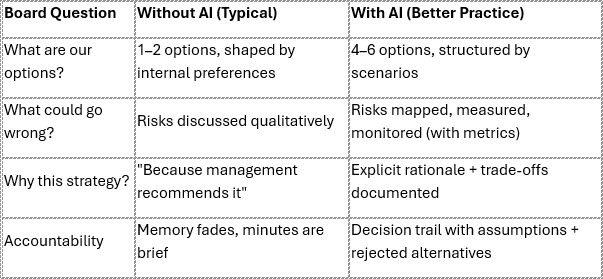
This kind of structure aligns strongly with modern governance thinking. The NIST AI Risk Management Framework (AI RMF 1.0) emphasizes lifecycle risk management and governance functions, govern, map, measure, manage that fit naturally into board oversight.
3) Human–AI synergy: the “AI excuse” must never be allowed
AI can support decisions, but it cannot own responsibility.
A mature organization never says:
- “We failed because the AI told us to.”
That’s not governance, that is blame-shifting.
The correct model is:
- AI proposes options, evidence, scenarios
- humans decide with values, context, and accountability
- the organization records why one option was chosen over others
This is where the conversation becomes powerful: AI strengthens accountability instead of weakening it.
Practical governance idea: the “Decision Rationale Log”
A board or executive committee can require a one-page decision record:
- the chosen path
- the 2–3 strongest alternatives
- why they were rejected
- key assumptions (and what will be monitored)
This style is consistent with the direction of modern AI governance standards, including ISO/IEC 42001:2023, which focuses on building an AI management system with risk management and lifecycle controls.
4) Economic impact: fewer bad bets, less waste, better growth
Now scale this up from one firm to the economy.
When companies:
- define products more accurately
- target customer needs better
- reduce wasteful launches
- lower rework and misalignment
- prevent avoidable bankruptcies
…you get a healthier innovation cycle.
This doesn’t mean failure disappears (business will always involve risk). But it does mean the economy spends less energy producing the wrong things and more energy producing value.
That also connects to sustainability: when we match supply to real demand better, we reduce excess inventory, unnecessary shipping, and wasted production. This is not just “green messaging”, it is operational math.
5) Jobs: the industrial-revolution pattern, in white-collar form
The comparison to industrial automation is grounded in history: automation shifts job categories. It replaces some tasks, but it also expands output, creates adjacent roles, and grows industries.
AI is doing something similar to white-collar work:
- routine drafting, summarizing, searching, basic analysis → increasingly automated
- higher-value work (judgment, stakeholder alignment, creative strategy, ethics, governance, client understanding) → becomes more important
Research and reporting document both productivity gains and workforce transformation as organizations adopt AI at scale. For example, data from 2024-2025 shows that while AI is automating some tasks, it’s simultaneously creating new roles in AI development, data science, and infrastructure with data center construction alone generating over 110,000 jobs in 2024.
The real issue is not whether jobs change, they will. The question is whether societies and companies:
- reskill fast enough
- redesign work around human strengths
- set governance so trust increases rather than collapses
That is why Gartner’s work on AI Trust, Risk and Security Management (AI TRiSM) matters: scaling AI requires monitoring, transparency, robustness, and data protection, not just deployment speed.
6) A practical “latest AI strategy” playbook leaders can adopt now
A. Start with high-impact use cases
- customer insight + segmentation
- pricing and revenue optimization
- supply chain risk and buffers
- finance forecasting and variance explanation
- board reporting synthesis + scenario generation
B. Build governance early (not after an incident)
- align to NIST AI RMF 1.0 concepts (govern/map/measure/manage)
- adopt an AI management system approach consistent with ISO/IEC 42001:2023
- implement AI TRiSM-style monitoring and security
C. Keep the human “in the loop” where it matters
- strategy decisions
- compliance and risk approvals
- customer-impacting outputs
- any high-stakes operational triggers
D. Measure what the board cares about
- cycle time reduction (decision speed)
- cost-to-serve drift
- waste reduction (returns, write-offs, excess inventory)
- improved forecast accuracy
- innovation hit rate (launch success ratio)
7) Conclusion: AI will not replace leadership, but it will expose it
AI won’t eliminate the need for humans. In fact, it may do the opposite: it will raise the standard for what humans must contribute.
When AI can instantly retrieve frameworks and generate strategic options, leaders can no longer hide behind:
- vague narratives
- untested assumptions
- politics disguised as strategy
- “we didn’t know”
And that’s why companies without AI are likely to fall behind: not because their people are bad, but because their operating model becomes slower, less informed, and less able to compete against organizations that learn at machine speed.
The winning future is not “AI-only.” It is:
- AI for memory, synthesis, and scenario breadth
- humans for judgment, responsibility, ethics, and meaning
And when that partnership is done well, the outcome is exactly what this article describes: better businesses, better use of resources, less waste, and a stronger economy.
References and Further Reading
- McKinsey & Company (2025). “The State of AI: Global Survey 2025.” Available at: https://www.mckinsey.com/capabilities/quantumblack/our-insights/the-state-of-ai
- National Institute of Standards and Technology (2023). “Artificial Intelligence Risk Management Framework (AI RMF 1.0).” NIST AI 100-1. Available at: https://www.nist.gov/itl/ai-risk-management-framework
- International Organization for Standardization (2023). “ISO/IEC 42001:2023 – Information technology — Artificial intelligence — Management system.” Available at: https://www.iso.org/standard/81230
- Gartner (2024). “AI Trust, Risk and Security Management (AI TRiSM).” Gartner Glossary. Available at: https://www.gartner.com/en/information-technology/glossary/ai-trism
Disclaimers
Professional Disclaimer: This article is provided for informational and educational purposes only. It does not constitute professional advice (legal, financial, or business consulting). Readers should conduct their own research and consult qualified professionals before making business decisions. The frameworks and standards referenced (NIST AI RMF, ISO/IEC 42001, Gartner AI TRiSM) are described for informational purposes; readers should refer to official documentation for implementation guidance.
No Warranties: While every effort has been made to ensure accuracy, the author makes no representations or warranties regarding the completeness, accuracy, or reliability of the information provided. The author shall not be held liable for any errors, omissions, or for any outcomes arising from the use of this information.
Source Attribution: This article references research and frameworks from McKinsey & Company, the National Institute of Standards and Technology (NIST), the International Organization for Standardization (ISO), and Gartner. All referenced organizations retain their respective trademarks and intellectual property rights. This article is an independent analysis and is not endorsed by any organization mentioned.
AI Assistance Declaration: This article was created with the assistance of artificial intelligence tools for research, analysis, and drafting. All content has been reviewed and refined by the author. The views and opinions expressed are those of the author.
This article was written by Dr John Ho, a professor of management research at the World Certification Institute (WCI). He has more than 4 decades of experience in technology and business management and has authored 28 books. Prof Ho holds a doctorate degree in Business Administration from Fairfax University (USA), and an MBA from Brunel University (UK). He is a Fellow of the Association of Chartered Certified Accountants (ACCA) as well as the Chartered Institute of Management Accountants (CIMA, UK). He is also a World Certified Master Professional (WCMP) and a Fellow at the World Certification Institute (FWCI).
ABOUT WORLD CERTIFICATION INSTITUTE (WCI)

World Certification Institute (WCI) is a global certifying and accrediting body that grants credential awards to individuals as well as accredits courses of organizations.
During the late 90s, several business leaders and eminent professors in the developed economies gathered to discuss the impact of globalization on occupational competence. The ad-hoc group met in Vienna and discussed the need to establish a global organization to accredit the skills and experiences of the workforce, so that they can be globally recognized as being competent in a specified field. A Task Group was formed in October 1999 and comprised eminent professors from the United States, United Kingdom, Germany, France, Canada, Australia, Spain, Netherlands, Sweden, and Singapore.
World Certification Institute (WCI) was officially established at the start of the new millennium and was first registered in the United States in 2003. Today, its professional activities are coordinated through Authorized and Accredited Centers in America, Europe, Asia, Oceania and Africa.
For more information about the world body, please visit website at https://worldcertification.org.


