 World Certification Institute – WCI | Global Certification Body World Certification Institute (WCI) is a global accrediting and certifying body that confers professional credentials to qualified individuals and accredits eligible courses offered by organizations such as universities, colleges, schools, professional institutions, and training companies.

Introduction
Artificial intelligence has traditionally been designed around one dominant objective: optimize everything. Whether minimizing prediction error, maximizing engagement, or identifying the statistically best solution, AI has become remarkably proficient at pursuing objectives with relentless efficiency.
Yet human decision-makers rarely operate this way.
Experienced executives, doctors, pilots, judges, and board directors understand that searching indefinitely for the perfect answer is often impractical, expensive, and even dangerous. Instead, they seek a solution that is sufficiently good, supported by credible evidence, aligned with organizational objectives, and delivered within an acceptable time.
This principle is known as satisficing, a concept introduced by Nobel Prize-winning economist Herbert A. Simon, who was honoured in 1978 for his pioneering research into decision-making within economic organizations. Rather than maximizing every objective, satisficing recognizes the reality of bounded rationality, the fact that decisions are constrained by limited information, limited computational resources, uncertainty, and time.
As enterprise AI evolves from predictive models into autonomous agents capable of initiating actions, the ability to determine when to stop reasoning becomes as important as determining what decision to make.
Programming intelligent stop rules may become one of the defining engineering disciplines of trustworthy AI.
Why Optimization Alone Is No Longer Enough
Modern AI systems can continue searching indefinitely for incremental improvements. Additional computations may increase confidence from 95% to 95.3%, then 95.31%, and so forth.
The question becomes: at what point does additional computation no longer produce meaningful business value?
Without carefully engineered stopping rules, AI systems may:
consume unnecessary computing resources,
delay critical decisions,
increase operational costs,
overfit data,
generate conflicting recommendations,
create governance uncertainty.
This challenge becomes particularly important as organizations deploy multi-agent AI architectures where several AI agents continuously exchange information before reaching consensus.
An AI that never knows when to stop thinking is not necessarily a smarter AI. Sometimes it is simply an expensive one.
Engineering the Stop Rule
Programming satisficing requires defining objective stopping conditions before the AI begins its reasoning process. Rather than asking the system to find the absolute best answer, the instruction becomes: find the best answer that satisfies predefined governance criteria.
This transforms AI from an optimizer into a disciplined decision-maker.
Core Stop Rule Components
| Engineering Component | Purpose |
|---|---|
| Confidence Threshold | Minimum confidence required before action |
| Evidence Quality Score | Reliability of supporting information |
| Objective Alignment Score | Consistency with business objectives |
| Risk Tolerance | Acceptable operational risk |
| Resource Budget | Maximum computation or cost allowed |
| Time Constraint | Maximum reasoning duration |
| Human Approval Trigger | Escalation point requiring human oversight |
Together these components define the AI’s decision boundary.
Confidence Thresholds
Confidence thresholds determine the minimum statistical certainty required before AI recommends an action. Illustrative examples include:
Medical diagnosis ≥ 99%
Financial fraud detection ≥ 98%
Inventory forecasting ≥ 90%
Marketing recommendations ≥ 80%
Different applications require different thresholds because the consequences of error vary dramatically. The objective is not maximizing confidence indefinitely. It is reaching sufficient confidence for the specific decision.
Evidence Quality Matters More Than Quantity
Large language models can generate extensive reasoning chains. However, more evidence does not necessarily mean better evidence.
Organizations should score information according to source credibility, data freshness, consistency, completeness, regulatory compliance, and explainability. For example:
| Evidence Source | Quality Score |
|---|---|
| Internal ERP transactions | Very High |
| Audited financial statements | Very High |
| Government databases | High |
| Peer-reviewed research | High |
| Public news | Medium |
| Social media | Low |
| Anonymous online forums | Very Low |
AI should stop searching once sufficient high-quality evidence has been obtained rather than accumulating endless lower-quality information.
Objective Alignment Scoring
Enterprise AI often faces multiple objectives simultaneously maximizing customer satisfaction, reducing operational cost, ensuring regulatory compliance, maintaining cybersecurity, and protecting corporate reputation. These objectives may conflict.
Programming satisficing requires assigning weighted alignment scores. Example:
| Objective | Weight | Current Score |
|---|---|---|
| Regulatory compliance | 35% | 100% |
| Customer experience | 25% | 92% |
| Profitability | 20% | 90% |
| Operational efficiency | 10% | 88% |
| Sustainability | 10% | 95% |
Overall Alignment Score: 94.1%
If the organization’s predefined acceptance level is 92%, the AI should stop and recommend action. Searching longer adds minimal business value.
Multi-Dimensional Stop Rules
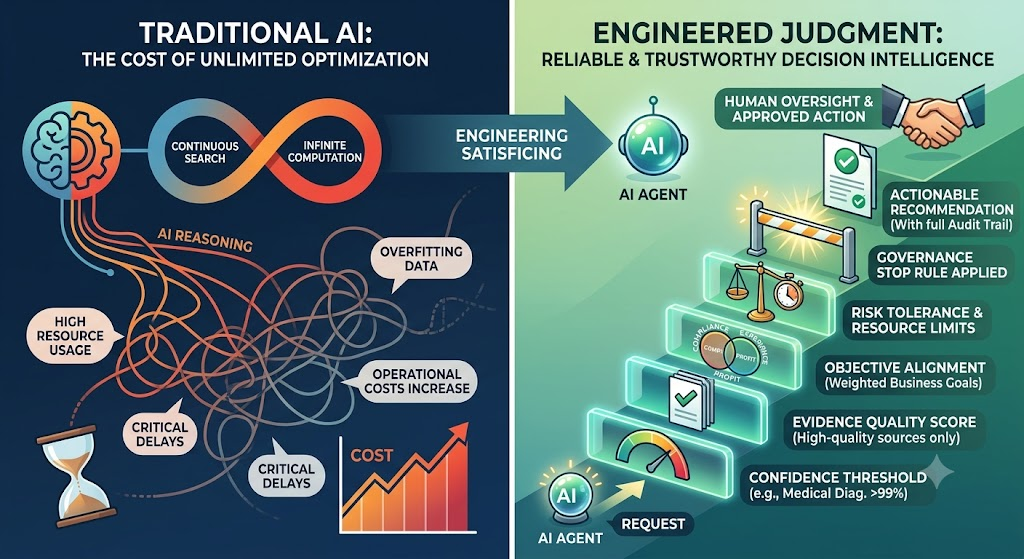
Traditional optimization focuses on a single metric. Modern enterprise AI requires multiple stopping conditions operating simultaneously, applied in layers:
Decision request received — the AI collects the available evidence.
Confidence check — if confidence is below threshold, gather more data; if above, proceed.
Quality check — if evidence quality is unacceptable, collect better data; if acceptable, proceed.
Alignment check — if business objectives are not met, continue the search; if met, STOP.
Recommendation generated — the decision is delivered with a full audit trail.
This layered approach reduces unnecessary computation while increasing decision consistency.
AI Agents Must Learn When Not to Continue
Recent advances in agentic AI have shifted attention from isolated models toward autonomous systems capable of planning, reasoning, using tools, and collaborating with other agents. Frameworks and safety research published by organizations such as OpenAI, Anthropic, and Google DeepMind increasingly emphasize controlled tool use, evaluation loops, and human oversight rather than unlimited autonomous reasoning. This reflects a growing industry understanding that effective AI is not measured solely by how long it can reason, but by how reliably it knows when it has enough evidence to act.
Without stopping mechanisms, autonomous agents may:
repeatedly verify identical information,
invoke unnecessary external tools,
generate excessive internal reasoning,
consume expensive compute resources,
increase latency,
produce inconsistent outputs.
Programming satisficing creates disciplined AI agents capable of terminating reasoning once governance objectives are achieved.
Governance Is the Hidden Engineering Layer
Programming stop rules is not merely a software engineering exercise. It is a governance discipline.
Boards should establish enterprise-wide policies covering acceptable confidence levels, acceptable uncertainty, escalation thresholds, mandatory human review, audit logging, decision explainability, and periodic recalibration.
International AI governance efforts, including ISO/IEC 42001:2023, the first international standard for artificial intelligence management systems encourage organizations to implement structured AI management systems with defined controls, accountability, risk management, and continual improvement. Embedding stop rules within these governance processes helps translate high-level AI principles into practical operational safeguards.
In this sense, stop rules become organizational policy expressed as software.
The Future: Dynamic Satisficing
Future AI systems will likely move beyond fixed thresholds. Instead, they will adjust stopping criteria dynamically according to context. Examples include:
higher confidence requirements during financial crises,
lower confidence requirements for low-risk routine automation,
stricter evidence requirements during regulatory investigations,
adaptive thresholds based on historical performance,
board-approved governance profiles for different business units.
Dynamic satisficing allows AI to remain both efficient and context-aware without compromising governance.
Conclusion
The next generation of AI will not be defined solely by larger models, more parameters, or longer reasoning chains. It will be distinguished by disciplined judgment.
Programming satisficing represents a shift from relentless optimization to purposeful decision-making. By embedding confidence thresholds, evidence quality standards, objective alignment scoring, resource limits, and governance controls, organizations can build AI systems that know not only how to think, but also when to stop.
That ability mirrors one of humanity’s most valuable decision-making skills: recognizing the point at which further analysis yields diminishing returns and responsible action should begin.
As autonomous AI becomes increasingly integrated into boardrooms, ERP platforms, healthcare, finance, and public administration, the most trustworthy systems may not be those that search the longest, but those engineered with the wisdom to stop at exactly the right moment.
Conceptual Infographic: Engineering Satisficing in AI
| Stage | AI Evaluation | Governance Question | Action |
|---|---|---|---|
| 1 | Collect evidence | Is the information reliable? | Validate |
| 2 | Measure confidence | Has the threshold been met? | Assess |
| 3 | Evaluate objective alignment | Does the recommendation support business goals? | Score |
| 4 | Check risk and resource limits | Is additional reasoning worthwhile? | Review |
| 5 | Apply stop rule | Are all governance criteria satisfied? | Stop and recommend |
| 6 | Human oversight (if required) | Does the decision require escalation? | Approve or refine |
References
1. Simon, Herbert A. Nobel Prize Lecture, 8 December 1978. The Sveriges Riksbank Prize in Economic Sciences in Memory of Alfred Nobel 1978, awarded for his pioneering research into the decision-making process within economic organizations. NobelPrize.org. https://www.nobelprize.org/prizes/economic-sciences/1978/simon/lecture/
2. Ho, Prof. Dr. John. Living Formula Reference System™ and Universal Reference Table™ — proprietary governance frameworks for responsible AI decision-making, deterministic checkpoints, and stop-rule architecture. Living Formula Series™, ProfitMark (S) Pte Ltd, Singapore.
Important Disclaimer — Please Read
This article is provided for general educational and thought-leadership purposes only. It does not constitute legal, financial, regulatory, engineering, medical, or professional advice of any kind, and it should not be relied upon as such. Readers should seek advice from appropriately qualified professionals before making any decision based on the ideas discussed here. All confidence thresholds, scores, weights, and figures presented are illustrative examples only and do not represent recommended operational settings for any organization or industry.
All views expressed are solely those of the author in his personal capacity and do not represent the views of any organization, institution, standards body, or company referenced. References to third-party organizations, publications, frameworks, and standards are made for identification and educational purposes only and do not imply any affiliation with, or endorsement by or of, those parties. All third-party trademarks, trade names, and standards referenced remain the property of their respective owners.
AI-Assistance Declaration: This article was researched and drafted with the assistance of artificial intelligence tools, with all content reviewed, verified, edited, and approved by the author, who retains full editorial responsibility. To the fullest extent permitted by law, the author disclaims all liability for any loss or damage, direct or indirect, arising from the use of, or reliance upon, this article or its contents.
🎨 Infographic Insight: This visual was conceptually designed and generated using Gemini (gemini.google.com) to illustrate the engineering shift from endless AI optimization to disciplined, trustworthy decision intelligence. Fully compliant with copyright, trademark, and privacy standards.
© 2026 Prof. Dr. John Ho. All rights reserved. Living Formula Series™ is a trademark of the author. No part of this article may be reproduced without written permission, except for brief quotations with proper attribution.
This article was written by Dr John Ho, a professor of management research at the World Certification Institute (WCI). He has more than 4 decades of experience in technology and business management and has authored 28 books. Prof Ho holds a doctorate degree in Business Administration from Fairfax University (USA), and an MBA from Brunel University (UK). He is a Fellow of the Association of Chartered Certified Accountants (ACCA) as well as the Chartered Institute of Management Accountants (CIMA, UK). He is also a World Certified Master Professional (WCMP) and a Fellow at the World Certification Institute (FWCI).
ABOUT WORLD CERTIFICATION INSTITUTE (WCI)

World Certification Institute (WCI) is a global certifying and accrediting body that grants credential awards to individuals as well as accredits courses of organizations.
During the late 90s, several business leaders and eminent professors in the developed economies gathered to discuss the impact of globalization on occupational competence. The ad-hoc group met in Vienna and discussed the need to establish a global organization to accredit the skills and experiences of the workforce, so that they can be globally recognized as being competent in a specified field. A Task Group was formed in October 1999 and comprised eminent professors from the United States, United Kingdom, Germany, France, Canada, Australia, Spain, Netherlands, Sweden, and Singapore.
World Certification Institute (WCI) was officially established at the start of the new millennium and was first registered in the United States in 2003. Today, its professional activities are coordinated through Authorized and Accredited Centers in America, Europe, Asia, Oceania and Africa.
For more information about the world body, please visit website at https://worldcertification.org.


