 World Certification Institute – WCI | Global Certification Body World Certification Institute (WCI) is a global accrediting and certifying body that confers professional credentials to qualified individuals and accredits eligible courses offered by organizations such as universities, colleges, schools, professional institutions, and training companies.

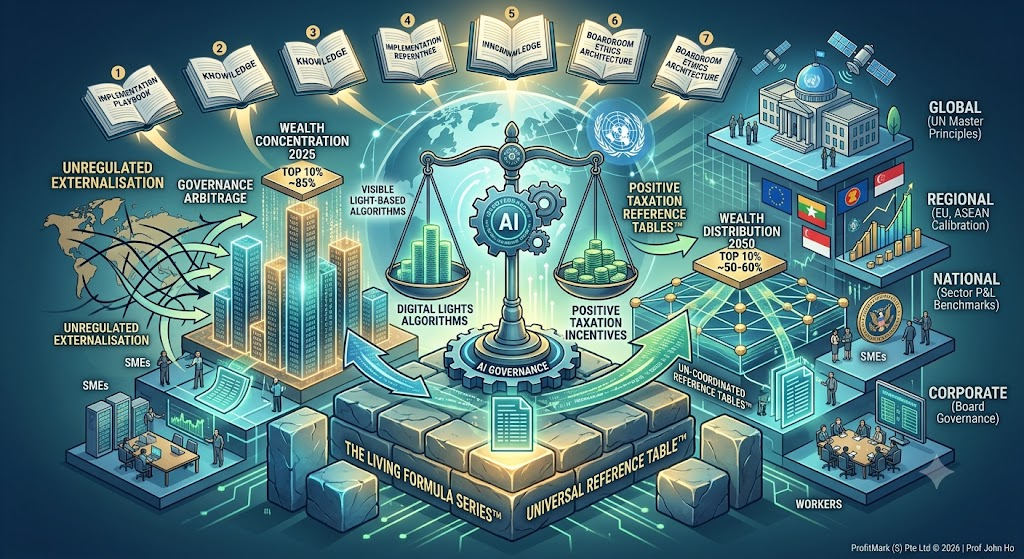
The Inequality That Governance Built And Governance Can Undo
The numbers are stark. According to Oxfam’s 2024 Inequality Inc. report, the wealthiest ten percent of the global population holds approximately 85 percent of the world’s wealth. The bottom fifty percent hold barely two percent. These are not natural outcomes. They are the product of governance systems or the absence of them that have allowed capital to accumulate at the top by externalising costs onto the many.
Pollution that poisons communities. Workers paid below living wages. Products engineered for premature obsolescence. Financial instruments that extract wealth from the most vulnerable. These are not individual moral failures; they are systemic outcomes of a global economic architecture that has never required companies to account for the full social cost of their operations. The profit flows to the shareholders. The costs flow to everyone else.
This final article in the Living Formula Series™ three-part taxation series makes the case that the Universal Reference Table™ scaled from the boardroom to the international stage offers a practical, AI-enabled pathway toward fairer global wealth distribution. Not through punitive redistribution, but through the alignment of governance incentives that makes ethical economic behaviour the rational choice at every level: from the SME to the multinational, from the nation-state to the United Nations.
Why Inequality Persists: The Governance Arbitrage Problem
The central mechanism behind wealth concentration is governance arbitrage: the ability of capital to relocate physically or financially to wherever governance standards are lowest and profit extraction is highest. Multinational corporations shift profits to low-tax jurisdictions. Supply chains migrate to regions with the weakest labour protections. Environmental standards get hollowed out when investors threaten relocation. The race to the bottom is not a metaphor. It is the operating logic of an uncoordinated global system.
Individual national governance frameworks however well-designed are structurally unable to stop this. A carbon tax in one country simply renders its manufacturers less competitive against those in countries with no equivalent obligation. A minimum wage floor in one jurisdiction shifts production to another. Without international coordination, every national attempt at ethical governance creates a competitive disadvantage for the country that tries hardest.
Without international coordination, every national attempt at ethical governance creates a competitive disadvantage for the country that tries hardest.
This is precisely the problem that a UN-coordinated Universal Reference Table™ is designed to solve. By establishing a common global baseline for what responsible corporate governance costs calibrated to sector, region, and development level, it removes the competitive incentive to race to the bottom. Capital can still flow freely. But it cannot escape governance.
Projected Wealth Distribution Under Phased Reference Table™ Adoption
| Phase | Governance Stage | Est. Wealth Held by Top 10% | Key Driver |
|---|---|---|---|
| Current (2025) | No coordinated standard | ~85% | Unregulated externalisation of costs |
| Phase 1 (2026–2030) | National Reference Tables™ adopted | ~75–80% | Positive taxation incentives at national level |
| Phase 2 (2031–2040) | Regional coordination (ASEAN, EU, AU) | ~65–70% | Cross-border governance alignment |
| Phase 3 (2041–2050) | UN-coordinated global Reference Table™ | ~50–60% | Capital cannot flee ethical governance |
Table 1: Indicative wealth distribution trajectory under phased Living Formula™ Reference Table adoption. Projections are illustrative and subject to macroeconomic variables. © 2026 John Ho | ProfitMark (S) Pte Ltd.
The Architecture of Global Governance: Four Levels, One Standard
The Living Formula™ framework is inherently scalable because it operates on a nested governance architecture. At each level, the reference table is adapted to local context while preserving the master principles established at the level above. This prevents both governance arbitrage and governance paralysis, the twin failure modes of international coordination efforts.
At the global level, the United Nations, working through its AI governance bodies and in concert with the OECD, World Bank, and relevant treaty organisations, establishes the master governance principles: the minimum standards for labour, environmental management, product safety, and financial ethics that all participating nations commit to embed in their national reference tables.
At the regional level, bodies such as the EU, ASEAN, the African Union, and the Gulf Cooperation Council adapt those master principles to their economic contexts calibrating benchmarks to regional industry norms, development levels, and existing regulatory frameworks. This is not a dilution of standards; it is a recognition that a fair wage benchmark in Singapore will differ numerically from one in Vietnam, while both reflect the same underlying governance principle.
At the national level, governments work with industry bodies to translate regional standards into sector-specific P&L benchmarks, which companies then customise for their own operations with board approval. The result is a governance system that is simultaneously global in principle, regional in calibration, national in implementation, and corporate in execution.
UN-Coordinated Reference Table™ Architecture
| Level | Body | Reference Table™ Role | Enforcement Mechanism |
|---|---|---|---|
| Global | United Nations / AI Governance Body | Sets master governance principles | Treaty obligations; trade incentives |
| Regional | EU, ASEAN, African Union, OECD | Adapts master table to regional context | Regulatory alignment; access conditions |
| National | Singapore NAIC, national tax authorities | Customises to national industry P&L norms | Tax incentives / levies; ERP audit |
| Corporate | Board of Directors | Approves company-specific variant | Internal / external audit; P&L governance |
Table 2: Four-level governance architecture for UN-coordinated Reference Table™ deployment. © 2026 John Ho | ProfitMark (S) Pte Ltd.
AI as the Global Governance Enforcer
The scale of a UN-coordinated governance framework would be impossible to administer through traditional bureaucratic means. This is where Living Formula AGI™ becomes indispensable. AI systems connected to national ERP infrastructure and reporting frameworks can monitor corporate compliance with reference table standards in real time — across thousands of companies simultaneously, in multiple jurisdictions, in multiple languages, across multiple sectors.
The critical advantage of AI-enabled governance at this scale is its consistency. A human inspector in Jakarta and a human auditor in Brussels will inevitably apply the same written standard differently. An AI system anchored to a universal reference table applies it identically, across every jurisdiction, at every reporting period, with no room for interpretation drift or regulatory capture.
An AI system anchored to a universal reference table applies it identically, across every jurisdiction, at every reporting period with no room for interpretation drift or regulatory capture.
This is not a speculative future. Singapore’s National AI Council (NAIC), established in February 2026 under Prime Minister Lawrence Wong’s chairmanship, is already working to align national AI governance across advanced manufacturing, finance, healthcare, and connectivity. The EU AI Act’s August 2025 obligations have created the regulatory infrastructure for AI transparency and accountability in the world’s largest single market. The OECD AI Principles provide the ethical framework. The pieces are already in place. What has been missing is the operational enforcement mechanism that converts these principles into auditable, P&L-embedded governance.
That is precisely what the Living Formula™ Reference Table provides. It is not a new bureaucracy; it is the missing connective tissue between principle and practice, a framework that transforms international commitments into line-item accountability.
Sector-Level Application: Where Governance Meets Wealth Distribution
| Sector | Reference Table™ Governance Focus | Wealth Distribution Impact | AI Governance Application |
|---|---|---|---|
| Manufacturing | Material quality; labour standards; emissions | Fairer wages; reduced environmental externalities | Multi-agent supply chain governance |
| Financial Services | Lending fairness; fee transparency; risk governance | Broader credit access; reduced wealth extraction | AI trading and credit-scoring guardrails |
| Technology / AI | Data ethics; worker classification; IP fairness | Platform worker protections; fair licensing | GPAI model governance; AGI accountability |
| Healthcare | Drug pricing; care quality ratios; access equity | Reduced health poverty; universal care investment | AI diagnostic governance; patient data ethics |
Table 3: Sector-level application of Reference Table™ governance and its wealth distribution impacts. © 2026 John Ho | ProfitMark (S) Pte Ltd.
The SME Pathway: Building Global Governance from the Ground Up
One of the most powerful features of the Living Formula™ global framework is its accessibility to small and medium-sized enterprises. Global governance conversations typically focus on multinationals, which have the resources to engage with complex regulatory frameworks and the leverage to negotiate exceptions. SMEs are usually left behind and with them, the communities and workers they sustain.
The Reference Table™ changes this. A small manufacturer in Malaysia, a logistics start-up in Nigeria, a fintech company in Jakarta each can adopt a customised reference table appropriate to their sector and scale, gain the tax incentives associated with governance compliance, and build a track record of ethical performance that becomes a competitive asset as global governance standards inevitably tighten.
Over time, these SMEs become the building blocks of a fairer global economy not because of top-down wealth redistribution, but because the governance architecture makes ethical operation economically rational at every scale. Companies that internalise their costs from the outset do not need to be corrected later. The system is self-reinforcing.
And as these governance-compliant SMEs grow, they become attractive acquisition targets or licensing partners for larger organisations seeking to demonstrate genuine ESG compliance rather than narrative compliance. The reference table becomes not merely a governance instrument, but a market signal of quality, trustworthiness, and long-term value.
The Seven-Book Vision: A Complete Governance Ecosystem
This three-part series has traced the arc of the Living Formula™ taxation framework from its philosophical foundations, the shift from punitive to preventive governance through its operational architecture P&L-embedded accountability enforced by AI and verified by layered audit to its ultimate vision: a UN-coordinated global governance compact that makes ethical economic behaviour the rational choice for every company, in every sector, in every country.
The Living Formula Series™ — seven books published through Amazon KDP provides the comprehensive intellectual and operational foundation for this vision. Books One through Five have established the framework, the implementation playbook, the boardroom ethics architecture, and the government governance model. Books Six and Seven will complete the ecosystem: a guide for AI companies seeking to embed reference table governance into their systems from day one, and a practical framework for start-ups and SMEs entering the AI governance space.
The concentration of 85 percent of global wealth in ten percent of hands is not an inevitability. It is a governance failure. And governance failures can be corrected.
The concentration of 85 percent of global wealth in ten percent of hands is not an inevitability. It is a governance failure. And governance failures can be corrected, not by punishment, not by redistribution, but by building systems that make the right thing the rational thing: from the first line of the P&L to the last decision of the most advanced AI agent.
The table is set. The framework is ready. The only question is whether the world’s leaders in boardrooms, in governments, and in the corridors of the United Nations are ready to sit down and govern right.
References
Ho, J. (2024–2025). The Living Formula Series™, Books 1–5. Amazon KDP. Available at: https://www.amazon.com
Oxfam International. (2024). Inequality Inc. Available at: https://www.oxfam.org/en/research/inequality-inc
Ministry of Digital Development and Information, Singapore. (2026). Update to Singapore’s National AI Strategy: Refreshed Priorities to Harness AI for the Public Good. Available at: https://www.mddi.gov.sg/newsroom/update-to-singapore-s-national-ai-strategy–refreshed-priorities-to-harness-ai-for-the-public-good-factsheet/
OECD. (2024). OECD AI Principles. OECD AI Policy Observatory. Available at: https://oecd.ai/en/ai-principles
United Nations Global Compact. (2024). The Ten Principles for Responsible Business. Available at: https://unglobalcompact.org/what-is-gc/mission/principles
Important Disclaimer — Please Read
AI-Assisted Authorship Declaration: This article was researched, structured, and edited with the assistance of Artificial Intelligence tools. All original intellectual property, frameworks, and proprietary concepts — including The Living Formula™, Universal Reference Table™, Living Formula Reference System™, Living Formula AGI™, Ego-Neutral Advisor™, Neutral Mirror™, and Indirect Advisory™ — are the exclusive intellectual property of Prof John Ho and ProfitMark (S) Pte Ltd. AI assistance was used solely as an editorial and research instrument under the direct supervision, editorial control, and final authorial authority of Prof John Ho.
General Disclaimer: The content of this article is provided for informational, educational, and thought leadership purposes only. It does not constitute legal, financial, tax, investment, regulatory, or professional advice of any kind. No reader should act or refrain from acting on the basis of this article without first obtaining independent professional advice specific to their circumstances. The projections, illustrations, and tables contained herein are indicative only and are subject to macroeconomic variables, policy developments, and other factors beyond the author’s control. Past governance frameworks and their outcomes do not guarantee future results.
Intellectual Property Notice: All trademarks, service marks, framework names, and methodologies referenced herein, including but not limited to The Living Formula™, Universal Reference Table™, Living Formula Series™, and Living Formula AGI™, are proprietary to Prof John Ho and ProfitMark (S) Pte Ltd. Unauthorised reproduction, adaptation, distribution, or commercial use of these frameworks, in whole or in part, without prior written consent from ProfitMark (S) Pte Ltd, may constitute trademark infringement, breach of copyright, and/or unfair competition and may result in civil or criminal liability under applicable law.
Reference Accuracy Notice: All external references cited in this article have been verified for accessibility and accuracy at the time of publication. URLs and source content are subject to change by their respective owners. The author accepts no responsibility for changes to third-party content after the publication date of this article.
No Liability: To the fullest extent permitted by applicable law, Prof John Ho and ProfitMark (S) Pte Ltd expressly disclaim all liability for any loss, damage, cost, or expense (including legal costs) arising directly or indirectly from reliance on, or use of, the information contained in this article. Readers assume full responsibility for their own decisions and actions.
Disclaimer: This infographic was conceptually designed and generated by Google Gemini to visually synthesize the core themes of Prof. John Ho’s The Living Formula Series™. All core concepts, metrics, and models—including the Universal Reference Table™ and the 4-level governance architecture—are the intellectual property of © 2026 John Ho | ProfitMark (S) Pte Ltd. Data visualizations are illustrative and intended to represent the theoretical economic trajectories detailed in the article series.
© 2026 Prof John Ho | ProfitMark (S) Pte Ltd | All Rights Reserved
The Living Formula Series™ | Article 3 of 3 | AI Governance, Ethics & Positive Taxation
This article was written by Dr John Ho, a professor of management research at the World Certification Institute (WCI). He has more than 4 decades of experience in technology and business management and has authored 28 books. Prof Ho holds a doctorate degree in Business Administration from Fairfax University (USA), and an MBA from Brunel University (UK). He is a Fellow of the Association of Chartered Certified Accountants (ACCA) as well as the Chartered Institute of Management Accountants (CIMA, UK). He is also a World Certified Master Professional (WCMP) and a Fellow at the World Certification Institute (FWCI).
ABOUT WORLD CERTIFICATION INSTITUTE (WCI)

World Certification Institute (WCI) is a global certifying and accrediting body that grants credential awards to individuals as well as accredits courses of organizations.
During the late 90s, several business leaders and eminent professors in the developed economies gathered to discuss the impact of globalization on occupational competence. The ad-hoc group met in Vienna and discussed the need to establish a global organization to accredit the skills and experiences of the workforce, so that they can be globally recognized as being competent in a specified field. A Task Group was formed in October 1999 and comprised eminent professors from the United States, United Kingdom, Germany, France, Canada, Australia, Spain, Netherlands, Sweden, and Singapore.
World Certification Institute (WCI) was officially established at the start of the new millennium and was first registered in the United States in 2003. Today, its professional activities are coordinated through Authorized and Accredited Centers in America, Europe, Asia, Oceania and Africa.
For more information about the world body, please visit website at https://worldcertification.org.


