 World Certification Institute – WCI | Global Certification Body World Certification Institute (WCI) is a global accrediting and certifying body that confers professional credentials to qualified individuals and accredits eligible courses offered by organizations such as universities, colleges, schools, professional institutions, and training companies.

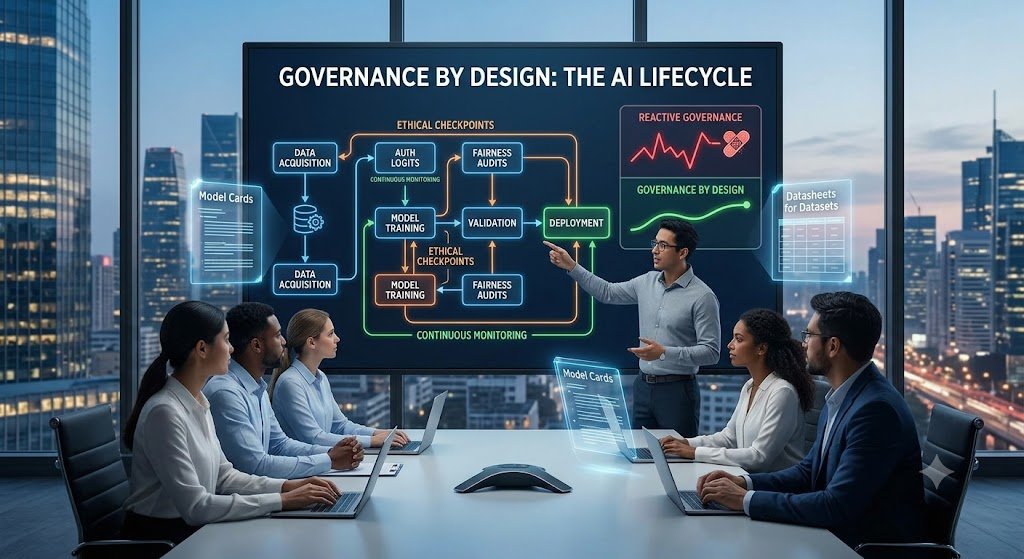
AI has moved from experiment to infrastructure, supporting healthcare, finance, education, government, and more. As it grows more autonomous and influential, ensuring it behaves responsibly matters as much as improving its performance. Yet most governance today is downstream moderating outputs, monitoring deployed systems, applying rules after models are already trained. This article proposes Governance by Design: integrating governance into every stage of the AI lifecycle, and treating it as a core engineering discipline rather than an external compliance activity.
Why Governance Must Move Upstream
Common challenges like misinformation, hallucinations, hidden bias, privacy, intellectual property, security, explainability, accountability, and regulatory compliance are often addressed only after deployment. But many of these problems are seeded much earlier, during data acquisition and training. The provocative question is therefore whether governance can begin before learning itself begins.
From Reactive Control to Governance by Design
| Reactive governance | Governance by Design |
|---|---|
| Develop → train → deploy → detect → patch | Design → govern → validate → train → monitor → improve |
| Controls applied at the application layer | Controls embedded across the full lifecycle |
| Problems found after they propagate | Risks caught before they propagate |
| Compliance as a final checklist | Governance as an engineering capability |
Governance Across the Lifecycle
Governance can be woven through every stage: evaluating legality, licensing, and provenance at data acquisition; assessing duplication, completeness, and factual reliability during knowledge engineering; validating semantic quality and representative coverage during curation; confirming consistency and compliance in quality assurance; monitoring fairness and anomalies during training; testing robustness, safety, and transparency at evaluation; implementing monitoring, audit logging, and incident reporting at deployment; and reviewing feedback, emerging risks, and evolving regulation during continuous learning. Governance becomes a continuous lifecycle, not a single checkpoint.
Principles That Travel
The framework rests on principles that adapt across legal and cultural contexts: transparency, accountability, fairness, privacy, security, reliability, sustainability, and respect for human dignity and agency. These align broadly with international efforts, the NIST AI Risk Management Framework organises trustworthy AI around the functions of govern, map, measure, and manage; ISO/IEC 42001 defines a certifiable AI management system; and the EU AI Act sets binding, risk-tiered obligations. Governance by Design is offered as a systems-level way to operationalise such principles rather than a replacement for them.
Engineering Governance In
Governance need not be a legal checklist bolted on at the end. It can be engineered into the system through policy-aware data pipelines, governance checkpoints, automated compliance validation, explainability mechanisms, audit trails, provenance tracking, and structured documentation such as datasheets and model cards. This transforms governance from a compliance function into an engineering capability that developers build and test like any other.
AI-Assisted, Human-Accountable
AI can support governance itself checking policy compliance, detecting anomalies and bias, generating documentation, scoring risk, verifying citations, and monitoring deployed models. But decisions carrying significant ethical, legal, or societal weight should remain under meaningful human oversight. AI should augment governance; it should not absorb accountability.
Measuring Governance
Governance needs measurable outcomes: a governance-compliance index, a transparency score, audit readiness, a human-oversight ratio for high-impact decisions, incident-resolution time, and an overall governance-maturity level. These complement, rather than replace, technical performance measures, and they let organisations improve governance deliberately over time.
Honest Challenges
Implementing Governance by Design is not free. It must balance innovation against regulation, avoid becoming bureaucratic theatre, keep pace with rapidly evolving models, coordinate across jurisdictions, manage cost, and define metrics that are meaningful rather than symbolic. Meeting these challenges requires collaboration among engineers, policymakers, legal experts, ethicists, and domain specialists which is precisely why governance belongs inside the engineering process.
Governance and Public Trust
Governance is not only a risk-control exercise; it is the foundation of public trust, and trust is fast becoming a strategic asset. People and institutions adopt AI they believe is fair, transparent, and accountable, and they withdraw from AI that surprises or harms them. A system whose decisions can be explained, whose data has known provenance, and whose failures are logged and addressed earns a licence to operate that no amount of raw capability can substitute for. In that sense, well-engineered governance is not a tax on innovation but an investment in its longevity.
Delivering this consistently across a global organisation is genuinely hard. Regulations differ by jurisdiction and evolve quickly; governance must remain practical rather than becoming symbolic paperwork; and metrics must measure something real. Promising research directions include adaptive governance frameworks, governance-aware model architectures, AI-assisted auditing, explainability metrics, and continuous compliance monitoring, an emerging field connecting AI engineering with governance science. The organisations that treat governance as a design discipline, refined and measured like any other, will be best placed to earn and keep the trust on which the whole enterprise ultimately depends.
It is tempting to frame governance and innovation as opponents, with every control purchased at the price of speed. The lifecycle view suggests the opposite. Risks caught early are cheap; risks discovered in production are expensive and public. Documentation created as work proceeds is nearly free; documentation reconstructed under audit is painful. By moving governance upstream and building it into the engineering itself, organisations tend to move faster over any meaningful horizon, not slower because they spend less time firefighting what careful design would have prevented.
Responsible by Construction
As AI becomes foundational to society, governance can no longer be an afterthought. Embedding ethics, transparency, accountability, and oversight throughout the lifecycle need not slow innovation; done well, it strengthens reliability and public trust. Alongside knowledge engineering and efficient infrastructure, Governance by Design forms the third pillar of the AI 2.0 framework distinguishing systems not only by how intelligently they compute, but by how responsibly they are built.
Key Takeaways
Trustworthy AI cannot rely on post-deployment safeguards alone.
Governance should span the entire lifecycle, from data acquisition to continuous learning.
Recognised frameworks like NIST AI RMF, ISO/IEC 42001, the EU AI Act can be operationalised by design.
AI can assist governance, but human accountability must remain intact.
Reflection Questions
Should governance become a mandatory engineering discipline for AI development?
Which governance activities are best performed by AI, and which require human judgment?
Future Research Questions
Can Governance by Design measurably reduce AI failures?
Which governance metrics best predict long-term trustworthiness?
Bridge to the Next Article
Governance by Design establishes where governance should occur. Article 8 asks who exercises it exploring Human–AI Collaborative Governance and risk-based oversight beyond the human-in-the-loop.
References
1. NIST (2023). Artificial Intelligence Risk Management Framework (AI RMF 1.0). U.S. National Institute of Standards and Technology.
2. ISO/IEC (2023). ISO/IEC 42001:2023 – Information technology – Artificial intelligence – Management system.
3. European Union (2024). Artificial Intelligence Act, Regulation (EU) 2024/1689. European Commission.
4. Mitchell, M. et al. (2019). Model Cards for Model Reporting. ACM FAccT.
5. Gebru, T. et al. (2021). Datasheets for Datasets. Communications of the ACM.
Important Disclaimer — Please Read
This article is provided for general informational and educational purposes only and reflects the personal views and original research proposals of the author. Several concepts presented here including AI Knowledge Engineering, Information Value per Token, and the AI 2.0 framework are forward-looking hypotheses offered to stimulate discussion, and are clearly distinguished from established scientific findings. They do not constitute professional, technical, financial, legal, or investment advice, and no reader should act upon them without independent verification and appropriate professional counsel.
All third-party facts, figures, standards, and frameworks are attributed to their original public sources, which readers are encouraged to consult directly; the author makes no warranty as to their ongoing accuracy or completeness. All product names, company names, standards, and trademarks are the property of their respective owners and are used for identification and commentary purposes only, without any claim of affiliation, sponsorship, or endorsement. No confidential or personal data has been used in preparing this article, and it complies with applicable privacy principles.
This is an AI-assisted article: research support, drafting, and data visualisation were produced with the help of artificial-intelligence tools and subsequently reviewed and edited by the author. To the fullest extent permitted by law, the author disclaims all liability for any loss or damage arising directly or indirectly from the use of, or reliance upon, the contents of this article. © 2026 Professor Dr. John Ho. All rights reserved.
This article was written by Dr John Ho, a professor of management research at the World Certification Institute (WCI). He has more than 4 decades of experience in technology and business management and has authored 28 books. Prof Ho holds a doctorate degree in Business Administration from Fairfax University (USA), and an MBA from Brunel University (UK). He is a Fellow of the Association of Chartered Certified Accountants (ACCA) as well as the Chartered Institute of Management Accountants (CIMA, UK). He is also a World Certified Master Professional (WCMP) and a Fellow at the World Certification Institute (FWCI).
ABOUT WORLD CERTIFICATION INSTITUTE (WCI)

World Certification Institute (WCI) is a global certifying and accrediting body that grants credential awards to individuals as well as accredits courses of organizations.
During the late 90s, several business leaders and eminent professors in the developed economies gathered to discuss the impact of globalization on occupational competence. The ad-hoc group met in Vienna and discussed the need to establish a global organization to accredit the skills and experiences of the workforce, so that they can be globally recognized as being competent in a specified field. A Task Group was formed in October 1999 and comprised eminent professors from the United States, United Kingdom, Germany, France, Canada, Australia, Spain, Netherlands, Sweden, and Singapore.
World Certification Institute (WCI) was officially established at the start of the new millennium and was first registered in the United States in 2003. Today, its professional activities are coordinated through Authorized and Accredited Centers in America, Europe, Asia, Oceania and Africa.
For more information about the world body, please visit website at https://worldcertification.org.


