 World Certification Institute – WCI | Global Certification Body World Certification Institute (WCI) is a global accrediting and certifying body that confers professional credentials to qualified individuals and accredits eligible courses offered by organizations such as universities, colleges, schools, professional institutions, and training companies.

The Shape of Success: What Thriving Companies Have in Common and How AI Makes It Visible to Everyone
How living, AI-powered benchmarks are replacing instinct in the boardroom — and why proportional thinking may be the most important strategic tool of our generation.
AI-Assisted
There is a moment that occurs in boardrooms more often than leaders care to admit. A proposal lands on the table, the numbers look defensible, the pressure is real and, in the absence of any deeper frame of reference, the decision passes through.
Months or years later, the consequences arrive quietly: a customer lost here, a quality compromise there, a slow erosion of the competitive edge that once seemed unassailable. This is not a failure of intelligence. It is a failure of architecture.
The most consequential decisions in any organisation are rarely the ones that feel dramatic. They are the incremental ones, the ingredient cut of eight percent to recover a squeezed margin, the R&D budget trimmed to meet a quarterly target, the supplier payment terms extended to improve short-term cash flow. Individually, each feels manageable. Collectively, they alter the structural shape of a business, moving it gradually away from the proportional patterns that define sustainable performance and toward a configuration that is subtly, invisibly, fragile.
What would it mean to make that structural shape visible in real time, at every meeting, for every leader?
The Proportional Truth About Successful Businesses
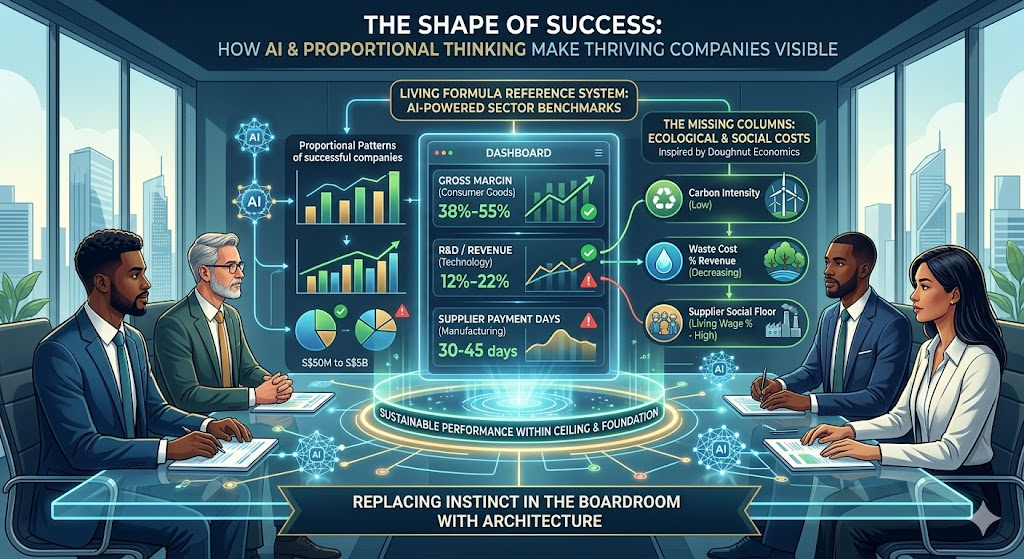
One of the most powerful insights in strategic management is that successful companies in the same sector share a recognisable shape, a proportional pattern of how revenue distributes across cost categories, investment, and profit. This is not about absolute size. A company generating S$50 million in annual revenue and one generating S$5 billion may share almost identical proportional structures. The shape is what matters.
| Sector | Metric | High-Performance Range | Signal |
|---|---|---|---|
| Consumer Goods | Gross Margin | 38% – 55% | Quality floor |
| Technology | R&D / Revenue | 12% – 22% | Future investment |
| Manufacturing | Supplier Payment Days | 30 – 45 days | Supply chain health |
These are not arbitrary thresholds. They are empirically derived patterns from organisations that have sustained excellent performance across time. And knowing them — truly knowing them, not as static benchmarks from a three-year-old consulting report, but as living reference points updated continuously from real company data — is the single most powerful diagnostic instrument available to any board. Fall below the technology R&D floor and you are not managing cost. You are consuming the future.
When the Data Speaks Without Accusation
The difference between a board that acts on instinct and one that acts on architecture is not a difference in the quality of its people. It is a difference in the quality of the information placed before them at the moment of decision.
Modern business intelligence has evolved far beyond descriptive and diagnostic reporting of historical activities, now incorporating real-time predictive analytics, AI-assisted querying, and scenario planning that provide genuinely data-driven answers to complex business questions. The implications for governance are profound. When a system can place, at the very moment a proposal is tabled, a reference table showing the proportional patterns of every comparable company that has sustained profitability across a ten-year period, the nature of the conversation changes entirely. The data speaks without accusation. The burden of proof shifts. Decisions become architectural rather than instinctive.
This is precisely what the Living Formula Reference System is designed to do — and why the word living is central to its identity. Unlike a static benchmark, which is a photograph of the past, a living formula is a continuously updated picture of what sustainable success looks like right now, in your sector, in your region. It adapts to local cost environments while preserving universal proportional patterns. It learns from outcomes, tracking which companies followed the formula and thrived, and which deviated and suffered.
The most dangerous decisions are not the bold, dramatic ones that attract scrutiny. They are the quiet, incremental ones that accumulate unchallenged until the structural fragility they create becomes impossible to ignore.
AI as the Great Democratiser of Pattern Recognition
For most of business history, the ability to read structural patterns has been the exclusive possession of the rare leader who has spent thirty or forty years developing intuition across multiple industries. They walk into a room, glance at a P&L, and know — in a way they cannot always articulate — that something is structurally wrong. This is what Daniel Kahneman identified as expert intuition: pattern recognition operating below the threshold of conscious reasoning, built from thousands of hours of feedback-rich experience.
The problem is that this kind of intuition is extraordinarily scarce. Most organisations — most boards, most leadership teams — do not have access to it. They make decisions based on the information placed before them, which is almost always historical, almost always internally generated, and almost always silent on the question of how their structural shape compares with the companies that have genuinely succeeded.
Artificial intelligence changes this equation fundamentally. The performance differential is no longer marginal, it is structural, and it is widening.
65% of early AI adopters use generative AI specifically for strategy.
56% of AI-adopting organisations exceed their business goals.
28% of conventional planners achieve equivalent goal outcomes.
AI-powered business intelligence platforms now integrate anomaly detection, predictive forecasting, and prescriptive recommendations directly into decision workflows — identifying inconsistencies that traditional filters miss and embedding insights into business operations rather than delivering them after the fact. For boards and leadership teams, this means the pattern recognition that once required decades to develop can now be made available at every meeting, for every decision, in every organisation — regardless of size or sector.
“The pattern recognition that once required decades to develop can now be made available at every meeting, for every decision, in every organisation.”
The Missing Columns: When Accounting Tells Half the Story
Traditional financial statements are structurally incomplete. They capture the financial costs of running a business — the money that moves between accounts — but they are silent on the ecological and social costs that flow outward into communities, supply chains, and natural systems. When a food company generates waste that damages a waterway, the cost of that damage does not appear on the company’s profit and loss statement. It appears on society’s balance sheet.
The ecological economics tradition, most rigorously articulated by scholars including Herman Daly, has long argued that this incompleteness is not a minor accounting technicality but a fundamental distortion of how business value is measured and governed. Kate Raworth’s Doughnut Economics framework, developed at the Doughnut Economics Action Lab, extends this argument into a practical governance tool: defining the social foundation below which human needs go unmet, and the ecological ceiling above which planetary systems are destabilised, and asking how business activity can thrive within that space rather than at its expense.
The Living Formula approach incorporates these missing columns directly into its reference tables. Waste cost as a percentage of revenue. Carbon intensity per unit of output. A supplier social floor indicator measuring whether supply chain participants are paying wages above the living-wage threshold. A biodiversity proxy for resource-intensive industries.
- Waste cost as a percentage of revenue — a practical efficiency and risk metric, not an ideological one.
- Carbon intensity per unit of output — increasingly material to regulatory exposure and investor appetite.
- A supplier social floor indicator — suppliers operating below living-wage thresholds represent fragile, quality-at-risk supply chains.
- A biodiversity proxy for resource-intensive industries — long-term licence-to-operate risk made visible.
These are not idealistic additions. They are practical risk indicators. A company whose suppliers are operating below the living-wage threshold is a company whose supply chain is fragile, whose reputational exposure is elevated, and whose long-term quality is quietly threatened. The planet’s costs, and society’s costs, always find their way back to the balance sheet — if not this quarter, then eventually.
From Financial Statements to Diagnostic Instruments
The power of this framework lies in the reframe it demands. Financial statements, in conventional use, answer historical questions: did we make money, do we have enough assets to cover our obligations? In the Living Formula framework, those same documents become prospective instruments — tools for identifying the gap between what happened and what should have happened, and for directing leadership attention precisely where it is needed.
As global data creation continues its exponential growth, traditional business intelligence falls further behind the pace of decision-making. Generative AI now addresses this core adoption gap by bringing natural language and AI-driven insights into everyday decisions, rather than reserving analytics for specialists with dedicated training. The diagnostic questions that the Living Formula makes answerable — where is the margin gap going, are we investing in the future or consuming it, what is our supplier payment policy actually costing us — are no longer the province of those with specialist analytical training. They become the operating vocabulary of every leadership conversation, in every organisation, at every level of seniority.
This is the deeper promise of the Living Formula Reference System: not merely better data, but better questions asked earlier, answered more reliably, and embedded into the architecture of governance itself. In a world where the business intelligence market is projected to grow from USD 29.81 billion in 2025 to USD 102.78 billion by 2030, the organisations that build this diagnostic capacity into their decision-making infrastructure will not simply outperform their peers. They will be operating in a structurally different category, one where the shape of success is always visible, always current, and always in the room.
The Boardroom of the Future
The boardroom of the future does not rely on instinct. It relies on architecture.
Architecture can be studied. It can be measured. It can be compared against the patterns of those who have built something that lasts. And unlike intuition — which is scarce, unequally distributed, and impossible to transfer — architecture can be built by any organisation willing to ask the right questions at the right moment.
The shape of success has always existed. AI is simply making it visible to everyone.
References & Further Reading
1. Raworth, K. — Doughnut Economics Action Lab: doughnuteconomics.org
2. PrometAI — Top Business Intelligence Trends 2025: prometai.app/blog/business-intelligence-trends-2025
3. AWS — What is Business Intelligence: aws.amazon.com/what-is/business-intelligence
4. Rollstack — Business Intelligence in the Age of AI: rollstack.com/articles/business-intelligence-in-the-age-of-ai-tools-strategy
5. Master of Code — Generative AI for Business Intelligence: masterofcode.com/blog/generative-ai-for-data-analytics
6. Kahneman, D. — Thinking, Fast and Slow (2011), Farrar, Straus and Giroux — on expert intuition and pattern recognition.
7. Daly, H. & Farley, J. — Ecological Economics: Principles and Applications (2004), Island Press — on the incompleteness of conventional financial accounting.
Important Disclaimer — Please Read
This article has been written by John Ho with the assistance of artificial intelligence (AI) tools for research, drafting, and editorial refinement. It is declared as an AI-assisted work in full transparency.
The views, frameworks, and opinions expressed in this article are those of the author alone and do not represent the position of any organisation, employer, client, or affiliated institution. All statistical data, market figures, and research citations have been sourced from publicly available third-party publications, which are listed in the References section above. The author has made reasonable efforts to verify the accuracy and availability of all cited sources at the time of publication; however, no warranty is made as to the ongoing accuracy, completeness, or fitness for any particular purpose of the information contained herein.
This article is intended for general informational and thought-leadership purposes only. It does not constitute financial, legal, investment, regulatory, or professional advice of any kind. Readers should conduct their own independent research and seek qualified professional advice before making any business, financial, or strategic decisions. The author accepts no liability for any direct, indirect, consequential, or incidental loss arising from reliance on the content of this article.
All trademarks, brand names, and product names referenced herein (including but not limited to Doughnut Economics Action Lab, PrometAI, AWS, Rollstack, and Master of Code) are the property of their respective owners. Their mention does not constitute endorsement of this article or its author, nor any commercial affiliation.
All intellectual property in the original expression, structure, and commentary of this article belongs to the author, John Ho. Reproduction, republication, or adaptation of any portion of this article in whole or in part, in any medium without the express written permission of the author is prohibited. Where AI-generated content has been incorporated, the author asserts editorial authorship over the final published work in accordance with applicable intellectual property conventions.
Image Disclaimer: This visual representation was conceptualized and generated by Gemini, Google’s AI, to illustrate the “Living Formula” and the shift toward AI-powered architectural decision-making in the boardroom. While the data points shown reflect the strategic benchmarks discussed in the text, they are for illustrative purposes to demonstrate how AI makes structural patterns visible in real-time.
© 2026 John Ho. All rights reserved.
This article was written by Dr John Ho, a professor of management research at the World Certification Institute (WCI). He has more than 4 decades of experience in technology and business management and has authored 28 books. Prof Ho holds a doctorate degree in Business Administration from Fairfax University (USA), and an MBA from Brunel University (UK). He is a Fellow of the Association of Chartered Certified Accountants (ACCA) as well as the Chartered Institute of Management Accountants (CIMA, UK). He is also a World Certified Master Professional (WCMP) and a Fellow at the World Certification Institute (FWCI).
ABOUT WORLD CERTIFICATION INSTITUTE (WCI)

World Certification Institute (WCI) is a global certifying and accrediting body that was established in 1992 in Washington, USA. Over the past three decades, WCI has certified thousands of professionals, companies and institutions around the world with its suite of internationally recognized certifications and has accredited many organizations with its accreditation standards.
WCI is dedicated to provide internationally recognized certifications and accreditation to individuals and organizations who demonstrate their desire to strive for excellence in their business and personal endeavors. WCI certifications and accreditation are recognized by companies and institutions around the world.
WCI partners with leading educational institutions, professional associations, and corporations around the world in providing its internationally recognized certification and accreditation programs.
For more information about the world body, please visit website at https://worldcertification.org.


