 World Certification Institute – WCI | Global Certification Body World Certification Institute (WCI) is a global accrediting and certifying body that confers professional credentials to qualified individuals and accredits eligible courses offered by organizations such as universities, colleges, schools, professional institutions, and training companies.
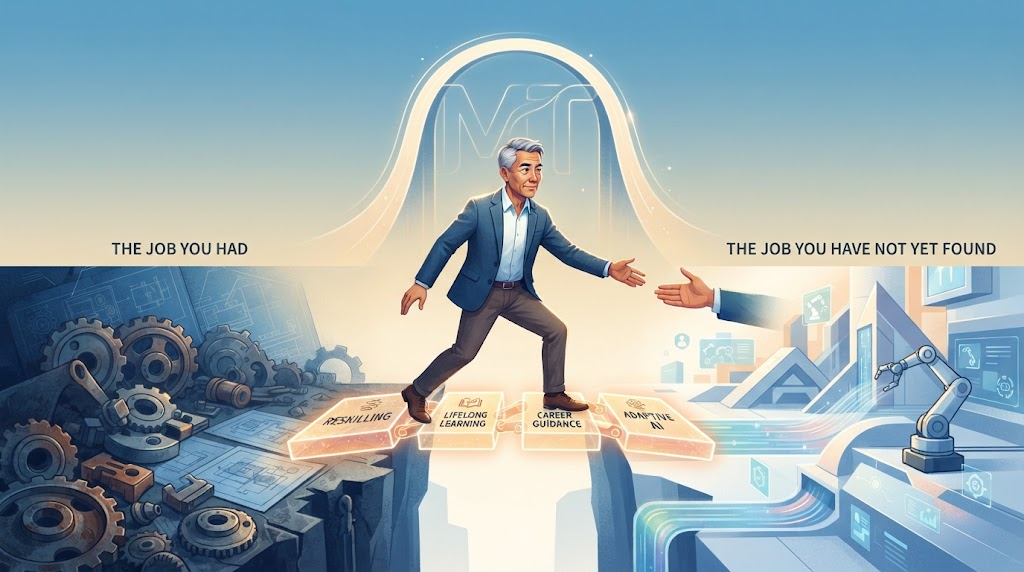
The future economy may well have work for everyone. But people do not live in the future. They live in the gap between the job they had and the job they have not yet found.
Consider Mr Tan, a composite drawn from many real situations. For twenty-six years he set machines at a small family firm that stamped metal brackets for air-conditioning units. He could hear when a press was about to fail and knew every customer’s habits. At fifty-eight, he expected to retire from the same workshop.
Then a regional competitor installed a fully automated stamping line, and its prices fell below anything his employer could match. Within eighteen months the firm closed. Mr Tan was not replaced by a robot in his own workshop. He was replaced by a robot in someone else’s.
That distinction matters. Much of the debate about AI and robotics asks whether machines will take jobs. The more useful question for leaders is who carries the cost of the transition, and for how long.
Aggregate gains, concentrated losses
Historical experience suggests that technological progress can create new employment opportunities over time. However, the short-term costs of displacement are often concentrated among workers and communities least able to adapt.
New roles demand different skills, appear in different places, favour different experience profiles and often start at lower pay. The people who lose jobs are not necessarily the people who gain the new opportunities.
The evidence on local effects is sobering. In their study of US labour markets from 1990 to 2007, published in the Journal of Political Economy in 2020, Daron Acemoglu and Pascual Restrepo estimated that one additional industrial robot per thousand workers lowered the national employment-to-population ratio by about 0.2 percentage points and wages by about 0.42 per cent. In the most exposed local labour markets, the effects were roughly twice as large. The gains spread across the economy; the losses settled on particular towns.
This is not only an economic issue. When people see others prosper while they fall behind, trust in institutions erodes. A transition handled carelessly can provoke the very backlash that stalls progress for everyone.
Who stands in the gap
Exposure is uneven. Four groups deserve particular attention.
Routine workers. Predictable tasks, physical or cognitive, are the easiest to automate. Employers surveyed by the World Economic Forum expect clerical roles such as cashiers, data-entry clerks and administrative assistants to be among the fastest-declining occupations by 2030.
Older workers. Deep but narrow expertise, family responsibilities and fewer years to recoup the cost of retraining make mid-career displacement especially hard. In ageing societies such as Singapore, losing experienced people to involuntary early retirement is a double loss.
Workers in small firms. Large companies can afford to automate and retrain. Small suppliers may be outcompeted before they can do either.
Young entrants. This risk is newer, and early evidence is emerging. A revised August 2026 Stanford Digital Economy Lab working paper by Erik Brynjolfsson, Bharat Chandar and Ruyu Chen, using US payroll data through June 2026, found that employment among workers aged 22 to 25 in AI-exposed occupations stood 19 per cent below where it would have been had it kept pace with less-exposed peers. The researchers found no comparable gap among experienced workers and no evidence of widespread economy-wide job displacement. The divergence appears to operate primarily through reduced hiring of young workers rather than increased separations. If the first rungs of the career ladder disappear, organisations may struggle to grow tomorrow’s senior talent.
The scale of the skills challenge
The World Economic Forum’s Future of Jobs Report 2025 offers a memorable picture. If the world’s workforce were 100 people, 59 would need training by 2030. Employers expect 29 could be upskilled in their current roles and 19 redeployed within their organisations. Eleven would be unlikely to receive the training they need, which the Forum puts at more than 120 million workers worldwide. Employers themselves rank skills gaps as the main barrier to business transformation.
Those eleven are the heart of the transition gap. They are the Mr Tans of the world.
Singapore: treating learning as infrastructure
If the problem is skills, part of the answer is learning that continues throughout a career. Singapore offers one of the more developed public models.
Under the SkillsFuture Level-Up Programme, Singapore citizens aged 40 and above received a S$4,000 SkillsFuture Credit top-up from May 2024. Eligible individuals undertaking qualifying full-time, long-form training can receive a Mid-Career Training Allowance of 50 per cent of their recent average income, between S$300 and S$3,000 a month, for up to 24 months over their lifetime.
The allowance is the decisive design choice. Many mid-career workers cannot afford to stop earning while they retrain. Partial income replacement turns retraining from a luxury into a realistic option.
The SkillsFuture Jobseeker Support scheme, launched in April 2025, adds a safety net. Eligible lower- and middle-income Singapore citizens who lose their jobs involuntarily can receive up to S$6,000 over six months, tapering month by month, provided they take part in active job-search activities. The support is designed to give breathing space while encouraging people to return to employment.
No country has solved the transition gap, and these schemes will need to evolve as AI accelerates. But they show that lifelong learning and income support can be treated as core national infrastructure, alongside roads and ports.
What responsible employers do
Governments cannot close the gap alone. The most effective retraining happens inside organisations, close to real work. Employers that redeploy rather than dismiss retain hard-won knowledge, earn loyalty and avoid the cost of hiring scarce talent.
There is also a financial argument. Replacing experienced employees involves recruitment, training and productivity costs. The loss of accumulated operational knowledge may take years to recover. Workforce transition should therefore be assessed not only as a labour cost, but as a capital allocation decision.
Yet short-term pressure often favours dismissal, because the saving shows in this quarter’s results while the cost of lost capability appears later.
Responsible employers also manage the pace of change. Announcing plans early, phasing in automation over months rather than weeks, offering affected staff first choice of new roles and relying on natural attrition can turn upheaval into a planned transition. In the transition gap, time is among the most valuable things an employer can give.
Professional bodies and educators matter too. Short, practical, industry-recognised certifications can give workers credible proof of new skills faster than a traditional degree.
Using AI to close the transition gap
The technology that disrupts work can also help people find new work. AI-assisted skills mapping can reveal hidden pathways: Mr Tan’s feel for machines under stress is directly relevant to robot maintenance and condition monitoring, though his job title would never suggest it. Adaptive AI tutors can help someone who has not studied for decades learn at their own pace. Matching platforms can connect people with roles based on capabilities rather than past titles. Human coaches, supported by AI, provide the encouragement and accountability that a job loss demands.
These tools need governance of their own. Hiring and matching algorithms can discriminate by age, gender, ethnicity or disability if trained on biased historical data. They should be tested for fairness, audited regularly and open to challenge, with human review of consequential decisions.
The EU AI Act classifies AI systems used in recruitment and certain forms of worker management as high-risk. Following the 2026 Digital Omnibus amendments, the relevant Annex III high-risk obligations are scheduled to apply from 2 December 2027. This illustrates why organisations should prepare governance arrangements before regulatory deadlines arrive.
The transition done well
In the composite story, Mr Tan’s path back was neither quick nor easy. Jobseeker support eased his immediate finances. A career coach saw what his job title had hidden. Using his SkillsFuture credit and training allowance, he completed a course in robot maintenance and condition monitoring. He then joined a manufacturer whose growing robot fleet needed someone who could hear a machine about to fail. He earned a little less at first, and more within two years.
Not every displaced worker will achieve this outcome. Some will need longer support, accept lower-paid work or require alternative pathways into retirement.
Mr Tan’s outcome needed a safety net, a training system, a thoughtful employer and considerable personal courage. Remove any one, and the story could have ended differently.
Govern automation, do not stop it
Left entirely to markets, automation may still create wealth, but unevenly: gains can concentrate among owners and highly skilled workers, while losses fall disproportionately on routine workers, older workers and small firms. That is not only unfair; it can also become economically self-defeating. People who lose income have less purchasing power to buy what automation makes cheaper, while communities that lose their industries may also lose part of their economic and tax base.
Ageing societies need automation too much to stop it. The task is to govern it, so that those who benefit from machines also invest in the people and communities affected by them.
One approach I have developed and discussed in my published Living Formula Series™ books is the Living Formula™ tax model. It proposes a more structured relationship between corporate tax assessment and a company’s economic, social and environmental responsibilities.
Under this proposed framework, tax authorities would use a well-managed, benchmarked company profit-and-loss statement (P&L) to assess performance against appropriate norms for the company’s industry, operating region and country. The intention is not to impose one universal cost structure on every business. Different industries and operating environments require different benchmarks.
Each company’s benchmarked P&L would be established through a governance process involving its Board of Directors. The Board would agree to the assessment framework, supported by its external auditor and comments and guidance from an independent auditor. This would provide greater accountability and a more transparent basis for assessing whether a company is contributing fairly to the wider economy.
The model would also examine whether expenditure in important areas falls materially below appropriate industry and regional norms. These could include staff-related expenditure, employee development, water management, pollution control and other environmental responsibilities. Where a company spends less than the established norm without adequate justification, the proposed framework would subject it to a higher tax assessment.
The principle is that companies should not be able to retain every saving simply by reducing expenditure in ways that transfer costs to employees, society or the environment. At the same time, legitimate efficiency improvements should be recognised, and benchmarks would need safeguards to distinguish genuine productivity gains from the externalisation of social and environmental costs.
This is particularly important in the age of AI. Automation can substantially reduce labour and operating costs. Without an appropriate governing system, much of those savings may flow primarily to company owners and shareholders, potentially widening the gap between those who own productive technology and those whose work is displaced by it.
The Living Formula proposal seeks to address this imbalance by making corporate tax assessment more closely reflect how companies manage and share the economic benefits they generate. Its objective is not to penalise automation or successful businesses. It is to encourage productivity growth while ensuring that employees, communities and the environment are not left carrying an unfair share of the cost.
This is a proposed framework, not a description of existing tax law. Its practical implementation would require careful calibration, transparent benchmarks, independent verification and safeguards against unintended consequences.
The quality of our AI future will be judged not only by what machines can do, but by how well we carry people across the gap.
What is your organisation doing to help people across it?
References
Acemoglu, D. and Restrepo, P. (2020). Robots and Jobs: Evidence from US Labor Markets. Journal of Political Economy, 128(6), 2188–2244.
World Economic Forum (2025). The Future of Jobs Report 2025: Digest.
Ministry of Education, Singapore (2025). Infosheet 2: Enhancing Support for Mid-Career Individuals under the SkillsFuture Level-Up Programme.
SkillsFuture Singapore. SkillsFuture Mid-Career Training Allowance.
Workforce Singapore (2025). Lower- and Middle-Income Involuntarily Unemployed Can Apply for SkillsFuture Jobseeker Support Scheme from 15 April.
Brynjolfsson, E., Chandar, B. and Chen, R. (2025, revised August 2026). Canaries in the Coal Mine? Six Facts about the Recent Employment Effects of Artificial Intelligence. Stanford Digital Economy Lab.
European Union (2026). Regulation (EU) 2026/1744 amending Regulation (EU) 2024/1689 concerning the simplification of the implementation of harmonised rules on artificial intelligence.
Disclaimers
AI-assistance disclosure
This article was prepared with the assistance of artificial intelligence tools, which supported drafting, editing and reference checking. The ideas, analysis, structure and final content were reviewed, revised and approved by the author, who takes full responsibility for the published text.
Author’s disclaimer
This article reflects the personal views and professional opinions of the author. It is published for general educational and discussion purposes only. It does not constitute legal, financial, tax, investment, employment or career advice, and should not be relied on as a substitute for advice from a qualified professional who knows your circumstances.
Mr Tan is a composite illustration created for this article. He does not represent any real, identifiable person, and any resemblance to actual persons or businesses is coincidental.
All information in this article, including research findings, statistics, projections, regulations and government policies, reflects publicly available sources at the date of publication and may change over time. Readers should consult the original sources for the latest position before relying on any information.
Research findings and statistics are attributed to their original publishers, who retain all rights in their work. References to organisations, programmes, laws and research are for commentary and do not imply endorsement by or affiliation with them. Living Formula™ and Living Formula Series™ are trademarks of the author. All other trademarks belong to their respective owners.
The views expressed are the author’s own and do not necessarily represent those of ProfitMark (S) Pte Ltd, the World Certified Institute or any other organisation with which the author is affiliated. While reasonable care has been taken to ensure accuracy at the date of publication, no warranty is given, and the author accepts no liability for any loss arising from reliance on this article.
Disclaimer for AI-Generated Image Content
This post features an image that has been generated with the assistance of generative AI (Gemini by Google). While the content and composition are inspired by professional themes and thought leadership, the depicted scenes and individuals are artistic representations and not literal photographs of actual events or specific persons. The visual narrative is intended for conceptual illustration and editorial purposes only.
This article was written by Dr John Ho, a professor of management research at the World Certification Institute (WCI). He has more than 4 decades of experience in technology and business management and has authored 28 books. Prof Ho holds a doctorate degree in Business Administration from Fairfax University (USA), and an MBA from Brunel University (UK). He is a Fellow of the Association of Chartered Certified Accountants (ACCA) as well as the Chartered Institute of Management Accountants (CIMA, UK). He is also a World Certified Master Professional (WCMP) and a Fellow at the World Certification Institute (FWCI).
ABOUT WORLD CERTIFICATION INSTITUTE (WCI)

World Certification Institute (WCI) is a global certifying and accrediting body that grants credential awards to individuals as well as accredits courses of organizations.
During the late 90s, several business leaders and eminent professors in the developed economies gathered to discuss the impact of globalization on occupational competence. The ad-hoc group met in Vienna and discussed the need to establish a global organization to accredit the skills and experiences of the workforce, so that they can be globally recognized as being competent in a specified field. A Task Group was formed in October 1999 and comprised eminent professors from the United States, United Kingdom, Germany, France, Canada, Australia, Spain, Netherlands, Sweden, and Singapore.
World Certification Institute (WCI) was officially established at the start of the new millennium and was first registered in the United States in 2003. Today, its professional activities are coordinated through Authorized and Accredited Centers in America, Europe, Asia, Oceania and Africa.
For more information about the world body, please visit website at https://worldcertification.org.


